Tuesday, January 12, 2010

Amazon comes to Egypt


Those familiar with Amazon will be pleased to hear that Egypt is now offering an online purchasing portal called Nefsak.
Browse many products online and pay either by credit card or cash on delivery.
Books, electronics, cosmetics, household appliances, computers, mobile phones, printers, software, movies, music.


Check out Nefsak here:

www.nefsak.com

read review here:

http://bikyamasr.com/?p=7403

Monday, January 4, 2010

Cairo Airport to Sinai by Airport Shuttle Bus.


Cairo airport run a fleet of brand new air conditioned mini buses which will transport you to any part of Sinai for a flat one off fee, no matter how many passengers.
It's a safer and more economical way of travelling around Egypt.

For example a trip from the airport to Ras Sidr is 430le flat fee fully inclusive for up to 7 passengers.

You can book online or call speed dial 19970 from Egypt.

FAQ

1- Is your fare based on a shared or a private ride?

Our system does not support shared rides. All our rides are private.

2. How long do I have to wait before a bus is ready for my ride?

If you are exiting the arrivals hall at the airport it’s a matter of a few minutes before you are on your way to your destination. If, however, you are calling from within the city, you’ll need to allow for the nearest available bus to reach you.

3. Are you going to charge me waiting time while I finish the customs and immigration procedures inside the airport?

The short answer is NO. In fact, you do not even need to reserve your ride in advance. Just exit the arrivals hall and look for our desk. Or call 19970 for service.

However, and only if you have called from inside the city and are heading to the airport (or elsewhere) you have to board the waiting bus within 30 minutes. After that period we begin to charge you waiting time.

4. Are your prices based on the number of persons in a party or are they per vehicle?

Our prices are a flat fee not based on the number of persons. You can invite your friends along as long as there are available seats on the bus.

5. What are the working hours for your buses?

24/7. We are at your service 24 hours a day and 7 days a week.

6. What is the estimated travel time between ………. and …………..?

This is a trick question for Cairo, but we do have an available schedule for your convenience. However, please do allow for extra time to be on the safe side.

7. I do not know the location of my hotel so I cannot estimate the fee … does your driver know the prices for all the Cairo destinations?

You can find most of the main hotels in Cairo in the following schedule. If your hotel is not listed in the schedule, drop us a line and we’ll inform you.

8. Exactly how near the hotel door will I be dropped off?

Our bus takes you right to the hotel main entrance. Our vehicles are shuttle buses and our prices are reasonable, but our service can really be compared to a limousine service.

9. Do you provide transportation to places other than Cairo?

Our service is available to any destination of your choice in Egypt.

10. Can you give me an example of fares for destinations outside Cairo?

This schedule may be of help. Just click on it.

11. Are your fares quoted in Egyptian Pounds?

Yes, all prices marked on the reservations page are in Egyptian Pounds.

12. Is the price inclusive of taxes and other fees?

Yes, prices include all taxes and fees.

13. Do prices change according to the time of day?

No. Prices are the same for all hours.

14. Can I pay in Dollars or Euros?

Yes, we accept payment in these currencies.

15. Are the prices quoted on the reservations page one way or return.

Prices are, of course, for a one-way trip.

16. Do you handle return trips?

Yes. A return trip (going to a given destination and back) with a maximum waiting time of 30 minutes between trips is charged at 1-1/2 times the basic one way trip. If, however, you need the bus to wait for more than 30 minutes, a waiting fee will be added. Contact the office (19970) to get a price.

17. Can the fare be paid by credit card or electronic transfer?

Unfortunately, for the time being it’s cash only unless you happen to be a frequent user with an open account with the company. We are planning to add prepayment by credit card and/or electronic transfer to our Web Site as soon as possible.

18. Where can I find the shuttle buses as I exit the arrivals hall?

You will see our reservations counter inside every arrival hall and our buses outside every arrival hall. Just look for Cairo Airport Shuttle Bus as you are exiting customs.

19. Can Cairo Airport Shuttle Bus take me from my Hotel to the Pyramids for example and back?

Yes. Our buses will take you anywhere in Egypt and back if needed. We can also arrange for a limousine with driver depending on the number of passengers.

Tuesday, December 29, 2009

The Goldstone Report Findings and Recommendations

090922-falk-goldstone


Findings:

The Mission found that, in the lead up to the Israeli military assault on Gaza, Israel imposed a blockade amounting to collective punishment and carried out a systematic policy of progressive isolation and deprivation of the Gaza Strip. During the military operation, houses, factories, wells, schools, hospitals, police stations and other public buildings were destroyed, with families, including the elderly and children, left living amid the rubble of their former dwellings long after the attacks ended, as no reconstruction has been possible due to the continuing blockade. Significant trauma, both immediate and long-term, has been suffered by the population of Gaza. More than 1400 people were killed. The Gaza military operations were directed by Israel at the people of Gaza as a whole, in furtherance of an overall policy aimed at punishing the Gaza population, and in a deliberate policy of disproportionate force aimed at the civilian population. The destruction of food supply installations, water sanitation systems, concrete factories and residential houses was the result of a deliberate and systematic policy to make the daily process of living, and dignified living, more difficult for the civilian population. Israeli forces also humiliated, dehumanized and carried out an assault on the dignity of the people in Gaza, through the use of human shields, unlawful detentions, unacceptable conditions of detention, the vandalizing of houses, the treatment of people when their houses were entered, graffiti on the walls, obscenities and racist slogans. The Israeli operations were carefully planned in all their phases as a deliberately disproportionate attack designed to punish, humiliate and terrorize a civilian population, radically diminish its local economic capacity both to work and to provide for itself, and to force upon it an ever increasing sense of dependency and vulnerability. Responsibility lies in the first place with those who designed, planned, ordered and oversaw the operations.

Israel failed to take feasible precautions required by international law to avoid or minimize loss of civilian life, injury to civilians and damage to civilian objects. The firing of white phosphorus shells over the UNRWA compound, the intentional strike at the Al Quds hospital using high explosive artillery shells and white phosphorous, the attack against Al Wafa hospital, were violations of international humanitarian law. The kinds of warnings issued by Israel in Gaza cannot be considered as sufficiently effective in the circumstances to comply with customary law. There were numerous instances of deliberate attacks on civilians and civilian objects (individuals, whole families, houses, mosques) in violation of the fundamental international humanitarian law principle of distinction, resulting in deaths and serious injuries. Israeli attacks were also launched with the intention of spreading terror among the civilian population. In several cases, Israeli armed forces did not allow humanitarian organisations access to the wounded and medical relief, as required by international law. In one incident investigated, involving the deaths of at least 35 Palestinians, the Mission found that Israeli forces launched an attack which a reasonable commander would have expected to cause excessive loss of civilian life. By deliberately attacking police stations and killing large numbers of policemen, most of whom were civilian non-combatants, Israel violated international humanitarian law.

The Mission found that Israel used white phosphorous, flechettes and heavy metal weapons. The use of white phosphorous, flechettes and heavy metal (such as tungsten) is restricted or even prohibited in certain circumstances. Flechettes, as an area weapon, are particularly unsuitable for use in urban settings while the Mission is of the view that the use of white phosphorous as an obscurant should be banned. The Mission also investigated several incidents in which Israeli armed forces used local Palestinian residents as human shields. Israel’s questioning of Palestinian civilians under threat of death or injury to extract information constitutes a violation of the Fourth Geneva Convention. Israeli forces in Gaza rounded up and detained large groups of persons protected under the Fourth Geneva Convention. Severe beatings, humiliating and degrading treatment and detention in foul conditions suffered by individuals in the Gaza Strip under the control of the Israeli forces and in detention in Israel, constitute a violation of international humanitarian and human rights law. Israel’s treatment of women during detention was contrary to the requirements of international law. Israel’s rounding-up of large groups of civilians and their prolonged detention under the circumstances described in the Report constitute a collective penalty and amounts to measures of intimidation or terror prohibited the Fourth Geneva Convention. Israel’s attacks against the Palestinian Legislative Council building and the main prison in Gaza constituted deliberate attacks on civilian objects in violation of international humanitarian law. Israeli armed forces unlawfully and wantonly attacked and destroyed without military necessity a number of food production facilities, drinking water installations, farms and animals. Israeli forces carried out widespread destruction of private residential houses, water wells and water tanks unlawfully and wantonly. Israel also disregarded the inviolability of United Nations premises, facilities and staff, and this is unacceptable.

Israel’s blockade of Gaza amounts to a violation of Israel’s obligations as an Occupying Power under the Fourth Geneva Convention. The deliberate actions of the Israeli forces and the declared policies of the Government indicate the intention to inflict collective punishment on the people of the Gaza Strip. Israel violated its obligation to allow free passage of all consignments of medical and hospital objects, food and clothing that were needed to meet the urgent humanitarian needs of the civilian population.

There is strong evidence that Israeli forces committed grave breaches of the Fourth Geneva Convention in Gaza, including: willful killing, torture or inhuman treatment, willfully causing great suffering or serious injury to body or health, and extensive destruction of property. As grave breaches, these acts give rise to individual criminal responsibility. The use of human shields also constitutes a war crime under the Rome Statute of the International Criminal Court. Israeli acts that deprive Palestinians in the Gaza Strip of their means of subsistence, employment, housing and water, that deny their freedom of movement and their right to leave and enter their own country, that limit their rights to access a court of law and an effective remedy, could lead a competent court to find that the crime of persecution, a crime against humanity, has been committed.

In the West Bank, with acts of violence by settlers against Palestinians (which have increased), Israel failed to protect the Palestinians, and sometimes acquiesced to the acts of violence. Israel used excessive force against Palestinian demonstrators, including the use of firearms, including live ammunition, and the use of snipers resulting in the deaths of demonstrators, in violation of international law. Israel has discriminatory “open fire regulations” for security forces dealing with demonstrations, based on the presence of persons with a particular nationality, violating the principle of non-discrimination in international law. Israel has failed to investigate, and when appropriate prosecute, acts by its agents or by third parties involving serious violations of international humanitarian law and human rights law. Israel’s removal of residential status from Palestinians could lead to virtual deportation and entail additional violations of other rights.

Israeli practices of detention of Palestinians in Israeli prisons before and during the military operations are generally inconsistent with human rights requirements. The practice of administrative detention by Israel contravenes the right not to be arbitrarily detained, and Israel’s use of secret evidence as a basis for the administrative detention is inconsistent with the ICCPR. The detention of members of the Palestinian Legislative Council by Israel is in violation of the ICCPR also constitutes an instance of collective punishment prohibited under article 33 of the GC IV. The same can be said about the massive detention of adults and children, often in inhuman or degrading conditions and without the guarantees required by international law.

Israeli checkpoints are often a site of humiliation. The extensive destruction and appropriation of property, including land confiscation and house demolitions in the West Bank including East Jerusalem, not justified by military necessity and carried out unlawfully and wantonly, amounts to a grave breach of the Geneva Conventions. The continued construction of settlements constitutes a violation of article 49 of the Fourth Geneva Convention. As movement and access restrictions, the settlements and their infrastructure, demographic policies vis-à-vis Jerusalem and Area C of the West bank, as well as the separation of Gaza from the West Bank, prevent a viable, contiguous and sovereign Palestinian state from arising, they are in violation of the ius cogens right to self-determination.

The prolonged situation of impunity has created a justice crisis in the OPT that warrants action. Israel’s system of investigation and prosecution of serious violations of human rights and humanitarian law, in particular of suspected war crimes and crimes against humanity, has major structural flaws that make the system inconsistent with international standards. The few investigations conducted by the Israeli authorities on alleged serious violations of international human rights and humanitarian law and, in particular, alleged war crimes, lack the required credibility and conformity with international standards. There is little potential for accountability for serious violations of international humanitarian and human rights law through domestic institutions in Israel.

Inside Israel, there has been intolerance for dissent against the war, the authorities placed obstacles in the way of protesters, there were instances of physical violence against protesters, and hostile retaliatory actions against civil society organisations by the Government. Activists were also compelled to attend interviews with the General Security Services. Israel’s denial of media access to Gaza and the continuing denial of access to human rights monitors are an attempt to remove the Government’s actions from public scrutiny and to impede investigations and reporting.

Palestinian armed groups have launched rockets and mortars into Israel since April 2001. Between 27 December 2008 and 18 January 2009, these attacks have left 4 people dead and hundreds injured, while causing terror, psychological trauma, and erosion of the educational, social, cultural and economic lives of the communities in southern Israel. For its part, Israel has not provided the same level of protection from rockets and mortars to affected Palestinian citizens as it has to Jewish citizens.

In firing rockets and mortars into Southern Israel, Palestinian armed groups operating in the Gaza Strip failed to distinguish between military targets and the civilian population and civilian objects in Southern Israel. Where there is no intended military target and the rockets and mortars are launched into civilian areas, they constitute a deliberate attack against the civilian population, which would constitute war crimes and may amount to crimes against humanity. The rocket and mortars attacks have caused terror in the affected communities of southern Israel, causing loss of life and physical and mental injury to civilians as well as damage to buildings and property. Israeli soldier Gilad Shalit meets the requirements for prisoner-of-war status under the Third Geneva Convention and should be protected, treated humanely and be allowed external communication. The Mission found no evidence to suggest that Palestinian armed groups in Gaza either directed civilians to areas where attacks were being launched or that they forced civilians to remain within the vicinity of the attacks. The Mission also found no evidence that members of Palestinian armed groups engaged in combat in civilian dress. In the one incident the Mission investigated, of an Israeli attack on a mosque, the Mission found that there was no indication that that mosque was used for military purposes or to shield military activities.

The Gaza authorities carried out extrajudicial executions, arbitrary arrest, detention and ill treatment of people, in particular political opponents, which constitute serious violations of human rights. The Palestinian Authority’s actions against political opponents in the West Bank also constitute violations of human rights. Detentions on political grounds violate the rights to liberty and security of person, to a fair trial and the right not to be discriminated against on the basis of one’s political opinion. Reports of torture and other forms of ill treatment during arrest and detention require prompt investigation and accountability. Finally, conflict between Fatah and Hamas is having adverse consequences for the human rights of the Palestinian population.

International law sets obligations on States to ensure compliance by other States (in this case, Israel) with international humanitarian law, and to help protect populations from war crimes and crimes against humanity. The international community has been largely silent and has to-date failed to act to ensure the protection of the civilian population in the Gaza Strip and generally in the OPT. The isolation of the Gaza authorities and the sanctions against the Gaza Strip have negatively impacted on the protection of the population. Protection of civilian populations requires respect for international law and accountability for violations.

To deny modes of accountability reinforces impunity. Allegations of violations of international humanitarian law falling within the jurisdiction of responsible Palestinian authorities in Gaza have also not been investigated. Where domestic authorities are unable or unwilling to comply with this obligation, international justice mechanisms must be activated to prevent impunity. There is little potential for accountability for serious violations of international humanitarian and human rights law through domestic institutions in Israel and even less in Gaza. Longstanding impunity has been a key factor in the perpetuation of violence in the region. Several of the violations referred to in this report amount to grave breaches of the Fourth Geneva Convention, and their is a duty imposed by the Geneva Conventions on all High Contracting Parties to search for and bring before their courts those responsible for the alleged violations. The serious violations of International Humanitarian Law recounted in this report fall within the subject-matter jurisdiction of the International Criminal Court (ICC). The prosecution of persons responsible for serious violations of international humanitarian law would contribute to ending such violations, to the protection of civilians and to the restoration and maintenance of peace.

Recommendations

  • To the Human Rights Council, that it Request the Secretary-General to bring this report to the attention of the Security Council under Art. 99 of the Charter so that the Security Council may consider action; and that it Submit the report to the General Assembly with a request that it should be considered;

  • To the United Nations Security Council, with regard to Israel, that it require the Government of Israel, under Article 40 of the Charter of the United Nations: To take all appropriate steps, within a period of three months, to launch appropriate investigations that are independent and in conformity with international standards; Inform the Security Council, within a further period of three months, of actions taken; Establish an independent committee of experts in International Humanitarian and Human Rights Law to monitor and report on any domestic legal or other proceedings undertaken by the Government of Israel; Upon receipt of the committee’s report the Security Council consider the situation and, in the absence of good faith investigations that are independent and in conformity with international standards, again acting under Chapter VII of the Charter of the United Nations, refer the situation in Gaza to the Prosecutor of the International Criminal Court.

  • To the United Nations Security Council, with regard to the relevant Palestinian authorities, that it: require the independent committee of experts (referred to in previous paragraph) to monitor and report on any domestic legal or other proceedings undertaken by the relevant authorities in the Gaza Strip; Upon receipt of the committee’s report the Security Council consider the situation and, in the absence of good faith investigations that are independent and in conformity with international standards, acting under Chapter VII of the Charter of the United Nations, refer the situation in Gaza to the Prosecutor of the International Criminal Court.

  • To the Prosecutor of the International Criminal Court, With reference to the declaration under article 12 (3) received by the Office of the Prosecutor of the ICC from the Government of Palestine, the legal determination should be made by the Prosecutor as expeditiously as possible; The Mission further recommends that the United Nations Human Rights Council formally submit this report to the Prosecutor of the ICC.

  • To the General Assembly, The Mission recommends that the General Assembly request the Security Council to report to it on measures taken with regard to ensuring accountability for serious violations of international humanitarian and human rights law; The GA may consider whether additional action within its powers is required in the interests of justice, including under resolution 377 (V) Uniting for Peace; Establish an escrow fund to be used to pay adequate compensation to Palestinians who have suffered loss and damage, and that the Government of Israel pay the required amounts into such fund; Ask the Government of Switzerland to convene a conference of the High Contracting Parties to the Fourth Geneva Convention of 1949 on measures to enforce the Convention in the OPT.

  • To Israel, The Mission recommends that Israel immediately cease the border closures and restrictions of passage through border crossings with the Gaza Strip, cease the restrictions on access to the sea for fishing purposes review its rules of engagement, standard operating procedures, open fire regulations and other guidance for military and security personnel; Allow freedom of movement for Palestinians within the OPT - within the West Bank including East Jerusalem, between the Gaza Strip and the West Bank and between the OPT and the outside world; lifts travel bans currently in place on Palestinians for their human rights or political activities; Release Palestinians who are detained in Israeli prisons in connection with the occupation; Cease the discriminatory treatment of Palestinian detainees. ; Release all members of the Palestinian Legislative Council currently in detention; Cease actions aimed at limiting the expression of criticism by civil society and members of the public Refrain from any action of reprisal against individuals and organizations that have cooperated with the UN Fact Finding Mission; respect the inviolability of UN premises and personnel; Provide reparation to the United Nations fully and without further delay.

  • To Palestinian armed groups, The Mission recommends that Palestinian armed groups undertake forthwith to respect international humanitarian law, and that Palestinian armed groups who hold Israeli soldier Gilad Shalit in detention release him on humanitarian grounds.

  • To responsible Palestinian authorities, Ensure prompt and independent investigation of all allegations of serious human rights violations by security forces under its control; Release without delay all political detainees currently in their power and refrain from further arrests on political grounds.

  • To the international community, States Parties to the Geneva Conventions of 1949 start criminal investigations in national courts, using universal jurisdiction, where there is sufficient evidence of the commission of grave breaches of the Geneva Conventions of 1949; Support the work of Palestinian and Israeli human rights organizations in documenting and publicly reporting on violations of human rights and international humanitarian law; States involved in peace negotiations between Israel and representatives of the Palestinian people, especially the Quartet, ensure that respect for the rule of law, international law and human rights assume a central role in internationally sponsored peace initiatives; Initiate a programme of environmental monitoring under the auspices of the United Nations.

  • To the international community and responsible Palestinian authorities, Establish appropriate mechanisms to ensure that the funds pledged by international donors for reconstruction activities in the Gaza strip are smoothly and efficiently disbursed.

  • To the international community, Israel and Palestinian authorities, Actors involved in the peace process should involve Israeli and Palestinian civil society and women in devising sustainable peace agreements based on respect for international law.

  • To the United Nations Secretary General, Develop a policy to integrate human rights in peace initiatives in which the United Nations is involved, especially the Quartet.

  • To the Office of the High Commissioner for Human Rights, Monitor the situation of persons who have cooperated with the UN Fact Finding Mission and pay attention to follow up to the Mission’s recommendations in its periodic reporting on the OPT to the Human Rights Council.
http://www.goldstone-report.org/the-report/the-contents/98-media-summary-report-of-the-united-nations-fact-finding-mission-on-the-gaza-conflict

El Nakba


Israel, the main opponent for Goldstone report is a brutal country. It has no human ethics since its establishment. It has massacred hundreds of thousands in Palestine, Egypt, Syria, Jordan and Lebanon. Israel never respected UN resolution nor any Humanitarian conventions like Geneva and other agreements.


The establishment of the State of Israel involved the destruction of over 530 Palestinian towns and villages and the expulsion of about two-thirds of the indigenous Palestinian Arab population from their homes and lands to pave the way for the establishment of a Jewish State, with a Jewish majority


Contrary to Israeli claims that they declared statehood in response to an Arab war against them, in actual fact, Zionist leaders launched a campaign of ethnic cleansing against the largely defenseless Palestinian population in April of 1948. A month and a half into this campaign, 380,000 Palestinians had faced expulsion, accounting for half of the total Palestinians made refugees in 1948, spawning an era in Palestinian history known as the Nakba (catastrophe).


This major offensive was Plan Dalet (Dalet – Hebrew for letter D). The Zionist leaders waged this campaign to control and ethnically cleanse territories beyond that allocated to the Jewish state by the UN Partition Plan (UNPP). By 1949, the Zionist leadership/Israeli government controlled 78% of Mandatory Palestine, having seized an additional 23% of the land allocated to Palestinian State under the UNPP.


According to Plan Dalet, the brigade commanders were given full "discretion" in what to do with the villages they occupied – that is to destroy them or leave them standing. On numerous occasions, Zionist forces expelled residents from their towns and villages, committed rape and other acts of violence, massacred civilians, and executed prisoners of war. These acts have been widely documented, most forcefully by Israeli historians using military and State archives. Here is one of many testimonies from Zionist soldiers:


"The first [wave] of conquerors killed about 80 to 100 [male] Arabs, women and children. The children they killed by breaking their heads with sticks. There was not a house without dead." He added that a soldier had bragged of raping and shooting a woman, two old women had been blown up in a house, and another woman with her baby were shot.*
New Jewish settlers migrated from across the world to inhabit the very same homes from which their rightful Palestinian owners had been expelled. Today these rightful owners are still denied the right to return to their homes.
The campaign to ethnically cleanse Palestine of its population entailed a brutal attempt to eliminate Palestinian identity, culture and heritage.


60 years on, Palestinians continue to be denied their internationally sanctioned rights to return to their homes, to self-determination and to live in full equality in their homeland.
A recent UN report condemned Israel’s on-going policies in the Occupied Territories as forms of foreign occupation, colonialism and apartheid – all in violation of international law.


No other "democracy" has so flagrantly breached international laws and UN resolutions as Israel has.
60 years on, Israel's practices of ethnic cleansing continue.


* Sources: Abu-Lughod, Lila & Sa’di Ahmad, 2007, Nakba: Palestine, 1948, and the Claims of Memory, ed, New York: Columbia University Press; Morris, Benny, 2004, The Birth of the Palestinian Refugee Problem Revisited, Cambridge: Cambridge University Press


http://www.goldstone-report.org/the-report/critics/99-israel-black-history-of-human-rights#addcomments

Monday, December 28, 2009

Viva Palestina Convoy


Egypt accused the French protesters of lying and trying to embarrass it [AFP]

Organisers of Viva Palestina aid convoy, which is trying to reach the Gaza Strip, have now agreed to go via Syria en route to Egypt.

The agreement came after a Turkish mediator reached a deal with the Egyptian consul in Jordan's Red Sea port of Aqaba.

The convoy will now head to the Syrian port of Latakia to sail from there to the Egyptian port of El Arish, and then to Gaza.

The Viva Palestina convoy, which has been stranded in Aqaba for the past five days, is led by George Galloway, a British MP.

Turkey dispatched an official on Saturday to try convince the Egyptians to allow the convoy to go through the Red Sea port of Nuweiba, the most direct route to Gaza after Egypt insisted that the convoy can only enter through El-Arish, on its Mediterranean coast.

Viva Palestina and another convoy, The Gaza Freedom March, were planning to arrive on Sunday to commemorate the first anniversary of Israel's war on Gaza that killed 1,400 Palestinians and 13 Israelis.

Meanwhile, at least 300 French participants of the Gaza Freedom March spent the night camped out in front of their embassy in Cairo, bringing a major road in the Egyptian capital to a halt as riot police wielding plexiglass shields surrounded them.

Egypt angry

Hossam Zaki, an Egyptian foreign ministry spokesman, accused the French protesters of lying and trying to embarrass Egypt.

In depth


"They claimed they had aid to carry to the Palestinians in the Gaza Strip, which is a lie," the MENA news agency quoted Zaki as saying.

"They want media exposure and to pressure and embarrass Egypt," he said.

On Sunday, police briefly detained 38 international participants in the Sinai town of El-Arish, organisers said.

"At noon (1000 GMT) on December 27, Egyptian security forces detained a group of 30 activists in their hotel in El-Arish as they prepared to leave for Gaza, placing them under house arrest.

"Another group of eight people, including American, British, Spanish, Japanese and Greek citizens, were detained at the bus station of El-Arish in the afternoon of December 27," they said.

On Sunday, Egyptian police also stopped some 200 protesters from renting boats on the Nile to hold a procession to commemorate those who died in the Gaza war.

On December 31, participants are hoping to join Palestinians "in a non-violent march from northern Gaza to the Erez-Israeli border," the organisers said.

http://english.aljazeera.net/news/middleeast/2009/12/200912281583520582.html

Sunday, December 13, 2009

Funeral of Mrs Kent Weeks

The funeral of Mrs Kent Weeks was held today in the Franciscan Church Luxor.

A memorial service will be held on Tuesday 15th December at 4pm In the Oriental Hall of the American University in Cairo, Tahrir Sq, Downtown Cairo.

Messages of condolence can be forwarded to Dr Kent Weeks through Dr Magdi Ali on
magdiali@aucegypt.edu

Dr and Mrs Kent Weeks

A 12-Foot-Wide Home on the Nile

Shawn Baldwin for The New York Times

The "Kingfisher," an 85-foot-long dahabiya, or traditional Nile riverboat, is owned by Dr. Kent Weeks and his wife, Susan.

Published: July 14, 2009

LUXOR, Egypt


Shawn Baldwin for The New York Times

The couple lives on the boat in Luxor, Egypt, for about six months of each year while they work on the excavation of a 130-room tomb in the nearby Valley of the Kings.

Kent Weeks and his wife, Susan Weeks, spend most of their waking hours in a 130-room tomb called KV 5 in the legendary Valley of the Kings, the site of many tombs. And at the end of the work day, they come home to a place only slightly less unusual.

The couple lives on a 25-meter-long (85-foot-long) dahabiya, a houseboat moored along the banks of the Nile in this southern Egyptian city of around 400,000, known in ancient times as Thebes. Their closest neighbors are the mummies in the Mummification Museum next door.

“Archaeologists often live on boats because the sites are near the river,” said Dr. Weeks, 67, an Egyptologist. He captured worldwide headlines in 1995 with the announcement that KV 5 had been the burial chamber for the sons of Rameses II and sprawled deeper into the desert hillside than anyone had suspected.

The couple, who have lived in Egypt for much of the last 43 years, first lived on a dahabiya in the 1960s while working with the Unesco team trying to save historic sites after the construction of the Aswan Dam.

The boats, which resemble traditional Arab sailing vessels, became popular more than a century ago when as many as 450 were used for the tourist trade. Only four or five remain from the period and “this handful survived because they had metal hulls,” Dr. Weeks said. “The rest were sunk to get rid of vermin.”

In 2001, after searching for 10 years, the couple found an iron-hulled boat in Helwan, a Nile town south of Cairo. It was built in 1898 or 1899, they learned.

“The boat was a total wreck,” said Mrs. Weeks, 65. The hull, wooden decking and walls were intact but they had to replace everything else, along with adding a kitchen and bathroom to the layout. “It is an imperfect reconstruction,” Dr. Weeks said. “In the 18th century you would go ashore to eat and to use the bathroom.”

By the time the work was finished, in 2003, the boat had about 84 square meters (900 square feet) of living space spread over two levels, as well as conveniences like a bathtub, a washing machine, a generator and water pump. The boat is called “Kingfisher,” in honor of the couple’s favorite bird.

The cost of buying and restoring the boat came to 250,000 Egyptian pounds ($50,000). The project was so unusual that there are no comparative prices readily available, although Dr. Weeks said he believes it could be sold now for about six times the sum they originally paid.

The couple spend about six months a year on the boat, dividing the rest of their time in London, Cairo and Old Lyme, Conn.

They often take their meals on the open deck, which is decorated with the wicker furniture and Oriental rugs common to colonial British décor.

Several steps lead down to the foredeck, where there are eight oar locks in the long open bow and a 30-meter-tall (98-foot-tall) mast that often supports two large triangular sails of linen — the boat has no motor. Two staff members, who help sail the vessel and act as guards, live on the boat year-round in an area below the foredeck.

The white-walled cabin contains four bedrooms as well as the kitchen and bathroom. All the plumbing uses filtered water from the Nile. “If you fill up the bathtub, the water is pretty brown,” Mrs. Weeks said.

At the end of the central corridor is the master bedroom, which has a raised platform for a bed, and storage space below. “Because the bed lies so far aft that the sides of the boat curve upwards, raising the bed makes more efficient use of space,” Dr. Weeks said.

The boat is only about 3.5 meters (12 feet) wide but “the narrower the boat, the faster it can go through the water,” Dr. Weeks said, as the boat sailed gently down the Nile in December.

The couple occasionally takes the boat out for special trips, especially to raise money for the Theban Mapping Project, an effort they began in 1978 to create a comprehensive archaeological database of the ancient city. Dr. Weeks is the project director; Mrs. Weeks, its artist.

“If we need to convince someone to donate money then we might take them for lunch down the Nile,” Dr. Weeks said. The couple also plays host to benefit tours operated by Seven Wonders Travel and Ancient World Tours.

The project’s most prominent achievement has been the KV 5 excavation; the tomb was discovered in 1825 but only after Dr. Weeks’s team cleared large areas did anyone realize its significance. “KV 5 is the largest tomb ever found in the Valley of the Kings, the oddest in plan and the only family mausoleum in which multiple sons of Egypt’s most powerful rulers were buried,” he said.

The couple reach the tomb by taking a colorful wooden boat across the river and then driving for 30 minutes along a dusty road, picking up some of the tomb workers en route. They usually are back onboard for lunch. “It is really very challenging putting a meal on the table when you have spent all day down a tomb,” Mrs. Weeks said.

Mr. and Mrs. Weeks say there are many advantages to living on the “Kingfisher,” including frequent bird-watching trips to remote islands. Still, there is a downside. “Sometimes there is a lot of tour-boat traffic,” Dr. Weeks said. “The captains toot their horns and it is just like being on a freeway in Southern California.”

But, he added, “We do interesting things — living on a boat, working in a tomb. Every day we see the sun come up and the sun go down. What more could you ask for?”

http://www.nytimes.com/2009/07/15/greathomesanddestinations/15gh-egypt.html

Director of the Theban Mapping Project's wife Susan Weeks drowns in Nile at Luxor


Susan Weeks the wife of Dr Kent Weeks body was recovered from the Nile in Luxor last night. It is unknown the cause of death. She was identified by her wedding ring inscription and photo by one of the librarians at Chicago House.
Mr Kent Weeks was the founder of the Theban Mapping Project in Luxor.

http://www.thebanmappingproject.com/about/staff_1.html

His wife Susan was a highly regarded Egyptologist and artist.

May she rest in peace.

Tuesday, December 1, 2009

Fingerprinting of UK Visa holders at border control


Fingerprint checks at the border
Entering the UK


From 30 November 2009, the UK Border Agency is introducing fingerprint checks at the border for passengers with biometric UK visas, entry clearances and identity cards for foreign nationals (ICFNs). This is being introduced incrementally at ports across the United Kingdom by March 2010.

The purpose of these checks is to verify that the individual entering the United Kingdom is the same person who applied for their visa, entry clearance or ICFN. Using fingerprints enables us to do this with greater certainty.

On arrival in the United Kingdom, trained Officers will scan two fingerprints on an electronic fingerprint reader at border control. In the majority of cases we will use the right hand thumb and first finger. These will then be checked against the fingerprints captured and stored as part of the application process for the visa, entry clearance or ICFN.

The fingerprint checks should take no longer than previous processing times for holders of visas, entry clearances and ICFNs. It may take additional time if there are difficulties scanning the fingerprints. There is no ink or mess involved in the process; passengers are simply required to place their fingers one at a time on the glass plate of the fingerprint reader.

Children age 6 and over are required to provide their fingerprints for checks however a responsible adult must be present when fingerprints are captured from children under the age of 16. There are certain exemptions from the fingerprint check process, please see below.

The fingerprint checks are an additional tool to verify identity; passengers will still be asked standard immigration related questions on arrival in the United Kingdom as normal. If the fingerprint check reveals any queries around identity, these matters may be resolved through an interview, but this will not routinely be required.

If a passenger refuses to provide their fingerprints for checking they will be subject to further investigations and this may result in a delay to their journey while a decision on admission is made.

Passengers will have to provide their fingerprints each time they travel to the United Kingdom with a visa, entry clearance or ICFN. Fingerprints will be held for a maximum of 48 hours, after which time they will be destroyed.

There is no charge for fingerprint checks.
Fingerprint Checks at the Border - Exemptions

The following passengers are exempt from fingerprint checks at the border:

* Passengers who are exempt from immigration control under section 8 of the Immigration act 1971 and who have therefore qualified for an 'exempt' endorsement will not have had their biometrics captured as part of the application process. These are:

- Serving Government Ministers of State (or their equivalents) recognised by Her Majesty's Government and travelling to the United Kingdom on the official business of their Government;

- Diplomats accredited to the United Kingdom; and

- Diplomats transiting to or from a place where they are accredited.

* Passengers who are not exempt from immigration control, but are not required to provide their biometric data:

- Diplomats visiting the United Kingdom on the official business of their Government; and

- Diplomatic couriers.

* Children aged under 6.

* Amputees - persons with less than two digits are exempt from the requirement to provide fingerprints as biometrics will not have been captured as part of the application process.
* Holders of right of abode - person holding a certificate of entitlement is not a person subject to the entry clearance requirement and biometrics will not have been captured as part of the application process.
* Passengers who will hold visas issued before the introduction of biometric visas. Biometrics will not have been captured as part of the application process.


http://www.ukba.homeoffice.gov.uk/travellingtotheuk/Enteringtheuk/fingerprint-checks-at-border/

Bayt al Lurd Services in Sinai


Bayt al Lurd


Consular Affairs and British Embassy contact on the Sinai Peninsula.


The British Honorary Consul to Sharm El Sheikh is
Ms. Dawn Bacon M.B.E.
She can be reached on Tel: 010 169 5074

or e mailed at

e-mail:
Dawn.Bacon-Honcon@fconet.fco.gov.uk


Thursday, November 26, 2009

Bir Madhkur Project Jordan 2010


2010 Season - Call for Volunteers

Volunteers are invited to join the 2010 season of the Bir Madhkur Project. The focus of the 2010 season will be on excavating the major features of Bir Madhkur (especially in the fort and domestic area), in addition to continuing the archaeological survey of the environs to further document the ancient Incense Route through the region.

Dates for the 2010 Season:

Full Season - June 6 – July 25

Partial Season #1 (2 weeks): June 6 – June 20
Partial Season #2 (2 weeks): June 20 – July 4
Partial Season #3 (3 weeks): July 4 – July 25

Deadlines:

January 15, 2010 - Deadline for Completed Application
February 1, 2010 - Due: Physicians Statement; Waiver; Completed Security Forms
March 1, 2010 - Deposit Due
April 15, 2010 - Final payment of dig fees

Eligibility & Acceptance:

There are no special requirements for eligibility. Volunteers must be at least 18 years of age and in GOOD HEALTH.

Generally, volunteers will be accepted on a first-come, first-served basis. Because some funding opportunities for volunteers (see below) carry January or early February deadlines, early applications are encouraged.

The Dig Camp & Camp Life:

Plans are to base the project’s dig camp at the site of Bir Madhkur itself. At present, Bir Madhkur is undergoing development to turn the site into a premier tourist village in southern Jordan, linked to the sites of Faynan and Petra, and within a short drive from the resort city of Aqaba. To that end, the housing units have been thoroughly renovated and newly furnished.

Contact the Project Director for further details.

Dig Fee:

* Cost: $2500 (full season = 7 weeks)

----------OR, one or more of the following options-----

Cost: $750 (partial season #1 = 2 weeks)

Cost: $750 (partial season #2 = 2 weeks)

Cost: $1125 (partial season #3 = 3 weeks)

Note: While on the project, dig fee covers room and board at the dig camp.

Deposit for dig fees: If accepted onto the project, you must send a deposit by March 1, 2010.

Deposit amounts: $400 for Full Season Participants

$300 for Partiall Season Participants


Insurance::

Volunteers and staff must arrange for their own medical/accident insurance. Proof of insurance is REQUIRED of all applicants.

Travel Arrange ments::

All international travel arrangments and costs are the responsibility of the applicant. Contact information for travel agents who offer low airfares to and from Jordan will be provided.


http://home.gwu.edu/~amsii/wadiarabaproject/bmp/bmp_digopps.html

Bir Madhkur Project

Dr. Andrew M. Smith II, Director


Introduction to the Project


Bir Madhkur, in the Araba valley of southern Jordan, is a major caravan station along the ancient Spice Route that connected the ancient city of Petra (just voted one of the “New Seven Wonders of the World”) with the Mediterranean port of Gaza. The site was occupied in the late Hellenistic (Nabataean), Roman, and Byzantine periods. The main features of the site include a Late Roman/Byzantine army fort, a domestic settlement surrounding the fort, a bath complex or an earlier caravan station, and various ancillary structures. Sites in the vicinity of Bir Madhkur include other caravan stations, farmhouses, and nomadic encampments.

The inhabitants of Bir Madhkur and of the sites in its territory were native peoples, whose economic survival was based on pastoralism, agriculture, and trade. These groups intermingled with non-native peoples, including pilgrims, merchants, and soldiers, who passed through or were stationed in the region throughout much of the Roman and Byzantine periods. The Bir Madhkur Project examines, through historical, archaeological, and ethnographic research, the relationships between these native and non-native populations. Emphasis is on revealing the function of Bir Madhkur as a regional center of social, economic, and cultural interaction and exchange.

In the 2009 season, the focus will be on conducting an archaeological survey of the environs of Bir Madhkur with special attention to mapping the ancient agricultural features. Limited survey will also be conducted documenting the course of the ancient Spice Route through the region.


Located near Wadi Namala, a principal route into Petra, Bir Madhkur is a major defensive structure situated in the foothills of esh-Shera, Jordan. Fritz Frank and Nelson Glueck both visited the site and noticed evidence of extensive agricultural activity in the immediate vicinity of Bir Madhkur (Glueck 1935; Frank 1934). Glueck also collected several coins from the area including one of Constantine (A.D. 306-337) and another of Constantius II (A.D. 337-361). As Director of the American Center of Oriental Research, David McCreery later visited Bir Madhkur collecting predominately Nabataean and Late Roman pottery. He was followed by King et al., whose pottery collected ranges in date from the Nabataean to Byzantine periods. This concurs with our own investigations at the site (McCreery, n.d.; King et al. 1987; Smith and Niemi 1994; Smith et al. 1997; Smith 1998; Perry and Smith 1999; Niemi and Smith 1999; Smith 2005).

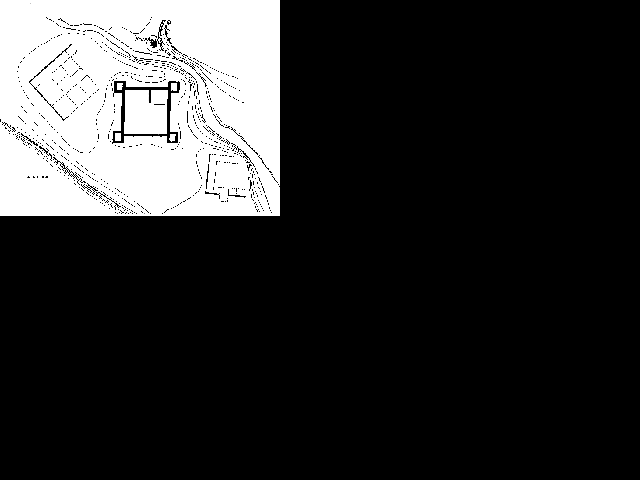
Commanding the site of Bir Madhkur is a small castellum, measuring just over 30 m square, which is a quadriburgium with four corner towers. The castellum here is in an exceedingly ruinous state with much of the northern wall destroyed by local bulldozing and robbing. The walls, two-courses wide, were constructed of worked limestone blocks. Compartments or rooms abut the interior of the curtain wall and surround an open courtyard. The location of the gateway into the fort could not be determined during the time of our visit but probably existed along the damaged northern wall. A large cemetery is located to the northeast.

Another structure, measuring ca. 30 x 25 m., is situated on the bank of a dry wadi ca. 34 m southeast of the fort. According to Glueck, this second structure may be a birkeh, and the large mound of ash just beyond the south wall of the structure may be evidence for local pottery production. There are reasons, however, to doubt these interpretations. Although the ruined condition of this structure does not allow for a clear identification of its nature, there is unmistakable evidence of partitioning along the south wall. Distinct wall alignments and linear mounds along the interior face of the south wall can be seen, suggesting that these rooms measured at least 5 x 5 m. Also of interest is a robber pit that had been excavated recently along the outer face of the east wall. This exposed a large quantity of pottery sherds as well as evidence that the exterior face of the wall had been plastered. Moreover, although the ash mound to the south contains a considerable amount of pottery sherds, not one kiln waster was found, and among the ceramic artifacts present there are a large number of fragmented pipes, tiles, and glass. With this new evidence, it is doubtful that this structure can be identified as a birkeh. Rather and more importantly, it may be a large bath complex or an earlier caravanserai.
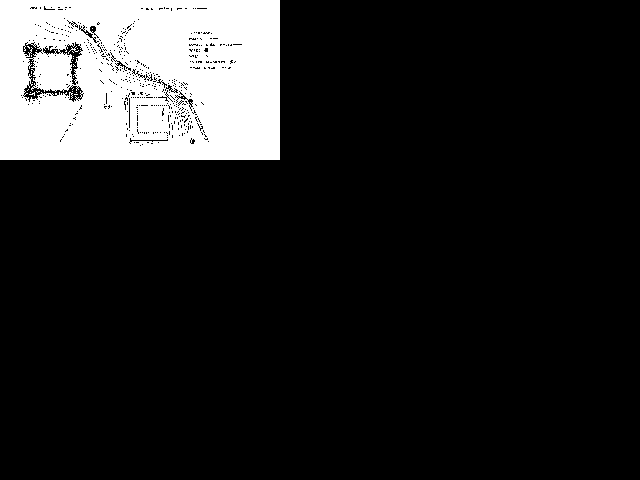
West and southwest of the castellum, Frank observed remnants of a complex of domestic houses. In an area of ca. 25 m square, numerous intersecting wall alignments and mounds indicate that this is a large complex of abutting structures. The exact nature and purpose of these constructions remain to be determined. Another smaller structure is situated ca. 18 m just south of the castellum. It measures ca. 18 x 10 m with roughly cut stone walls measuring ca. 0.80 m thick. The entrance into this structure is along the west wall, and there is evidence of at least six internal rooms.

Albrecht Alt was the first scholar to attempt an identification of Bir Madhkur, suggesting that it might be the site of ancient Moa (Alt 1935: 7, 24, 26, 31, 47). Other scholars, however, proposed to identify Bir Madhkur with Calamona of the Notitia, the base of a Cohors prima equitata (Not. Dign. [Or.] 34.43; Avi-Yonah 1976: 45; Rothenberg 1971: 217) Alt identifies Calamona with Ellebana of the Beersheva Edict, but does not attempt to identify or locate the settlement (Alt 1935: 26). The ancient identity of Bir Madhkur, despite previous attempts to assign an ancient place-name to the settlement, remains uncertain.

Project Summary

As a component of the Wadi Araba Archaeological Research Project (WAARP), the Bir Madhkur Project, directed by Dr. Andrew M. Smith II, seeks to examine the economic, social, and cultural history of the ancient site of Bir Madhkur, located on the eastern fringe of Wadi Araba southwest of Petra. The research design consists of three main components: 1) continuation of a regional archaeological, environmental, and ethnographic survey of the environs of Bir Madhkur (the Central Wadi Araba Archaeological Survey), 2) excavation of the ancient settlement to learn more of its history and role in the regional economy, society, and culture of southern Jordan and Israel, 3) analysis of artifacts and other evidence of the material culture relevant to the regional economy, society, and culture. This research is expected to reveal potential new evidence regarding the history and organization of the regional economy, its political and military significance in a frontier zone, and the social and cultural identity and lifestyle of those who occupied the site.


http://home.gwu.edu/~amsii/wadiarabaproject/bmp/birmadhkur.html


Thursday, November 19, 2009

Sinai Medicinal Plants Conservation Project.


http://www.mpcpegypt.com/index.html

Medicinal and Aromatic Plants

With its high mountains and deep wadis in the southern Sinai Peninsula and its relatively unexplored desert ecosystem of flora and fauna, the St. Katherine Protectorate is a truly amazing, unique and important area.

The global significance of species found in the St. Katherine’s Protectorate is not only related to the uniqueness of flora and habitat, but also due to use value. At least 47% have medicinal, aromatic, cosmetic or culinary uses, in addition to being used as fodder or fuel.

While previous plant inventories recorded 529 plant species within the boundaries of the protectorate, only 316 plant species were recorded, of which 33 species are endemic. Additionally, the disappearance of, or at least the difficulty to locate, 213 species confirms that the medicinal plants face a growing danger of damage and in the worst case extinction, which in turn will effect the global plant biodiversity.

To achieve the objectives of the project a pamphlet guide has been released illustrating the most economically beneficial medicinal plants of the region. The pamphlet serves as a simplified guide for those interested in the cultivation of medicinal plants.

You can browse our database and find out more about the work of the MPCP, such as latest news, products handmade by the Bedouins, the Green School program which educates children about medicinal plants, and our accomplishments by reading the position papers. Lastly, we wish you a inspiring, educating and interesting stay on our homepage.Click link above to view.


Climb 3 peaks in Sinai


Location: Sinai

Date & Time: Saturday, November 28, 2009 at 1:00pm - 1 Dec. 10 pm

Description:

4 Days / 3 Nights Hiking trip to three peaks


Egypt's Highest Peak is Mount Catherine, some confuse it with Mount Moses,
Mount Moses: many of us has hiked before, a little over 2.4 thousand meters above sea level
Mount Catherine is little higher, a little over 2.6 thousand meters, again above sea level, that is the height of the mountain, not how high we hike, we start the hike from the city of Saint Catherine, which is above sea level anyways.
El Ahmar Mountain: not as high but with no trail.

There is no climbing involved, only walking up.

An attempt to hike up three summits in less than three days, then spend some time by the beach. It is not a race nor is it a challenge, you will have the option of doing one, two or the three summits. For the detailed itinerary please email sales @ holiday.com.eg

Cost per person:
EGP670

Price Includes:
-----------------
• 1 Night accommodation in a shared bedroom at a camp in Nuweiba.
• 2 Night accommodation in the mountains.
• Transportation Cairo/Saint Catherine/Neweiba/Cairo in air-conditioned tourist bus.
• Dinner meals.
• Guides.
• Registrations.
• Taxes and service charge.


For Reservation:
--------------------
-Call Khaled on 016 5377447 016 5377447 (between 10am and 10pm) to sign up.
-Please send a photocopy of your National ID/Passport to sales @ holiday.com.eg

- 4% Discount for GUC students.

Tuesday, November 3, 2009

Property Tax in Egypt

Property Tax Law 2008 and FAQ's on Egypt's Property Tax Laws, plus downloadable Tax Forms.


http://www.mof.gov.eg/English/Real+Estate+Tax.htm