Monday, April 26, 2010

Centre for Sinai

CENTRE FOR SINAI:

is a non-profit, non-governmental organization created in 1998 by Ahmed El-Sadek, Motaz Ahmed, and Ezzat Abdelmaguid together with their Sinai Bedouin friends .Our aim is to highlight and preserve the culture and history of this tiny peninsula which is as old as time immemorial. There is very little literature about the Sinai and any interested person would have to do a lot of research to get any in-depth information .We therefore attempt to present our knowledge and research of the Sinai and related topics to the outside world from an insider’s perspective

We seek to promote the Sinai in a positive and academic perspective, emphasizing the importance of the local Bedouin population as a major contributor to its culture and future. Our very existence aims to further preserve this native culture in their native home by providing work and insuring steady incomes for those very few families who choose not to change their traditional way of life, preferring to stay in the desert, keeping this culture alive and prosperous. It would be a great shame and loss to the whole world if this culture were to disappear like many others before it. This is after all the only culture that preserves the way of life of the Old Testament Patriarchs of the Judeo-Christian tradition. They also preserve the culture of the Prophet Mohammed and the early followers of Islam in its purity

ISLAM, meaning to give up to God’s will and accept fate as it has been preordained by the greater unknown power of the Creator, was the religion of Abraham. He accepted to slaughter his son as he was ordered to do and thus he became the first Moslem.

Abraham had two sons. Ishmael and Isaac. From Isaac was the Hebrew nation born, although not all Jews are descendant from him. Ashkenazi Jews are the descendents of the Khazars who converted to Judaism only to remain neutral in the feud between the Christian Byzantine Empire on one hand and the new Moslem Empire on the other. His elder son, Ishmael, had seven sons and they are the ancestors of all Arabs.

CONCLUSION ; Semitic Jews and Arabs are cousins. When an Israeli accuses an Arab of being Anti Semitic, this is ridiculous. Arabs ARE Semitic.

Even before the Diaspora, the Jews had lost their native culture intermingling with the peoples of the Middle East. The Moslem Arabs also mingled with the different cultures of North Africa and the Middle East, like the Jews keeping only the religion while losing the traditions of the desert.

CONLUSION ; Only the Bedouins who have absolutely not changed since the times of Abraham are pure blooded Semitic nomads. It is only through living or traveling with the Bedouins that one can get a feeling for life as it was in the ages of Abraham, Isaac, Jacob, Joseph, Moses, Jesus Christ and Muhammad.

The Bedouins of south Sinai have been the poorest of all because they lived in the remote mountains and were not on any main route of commerce. They had almost no contact with the rest of the world and are therefore the purest in blood and tradition. It is this culture of the original Arab that CENTRE FOR SINAI hopes to preserve and rekindle.

We depend on our own private means to finance and upkeep the center using our knowledge of the Sinai and our very good relations with the local community to further finance it. We offer expeditions through different regions of south and central Sinai for many reasons:

- Preservation of the native culture of Sinai
- Exploration of new areas
- Providing income for the native desert dwelling population
- Systematic collection of garbage during our expeditions (sinai-clean-up)
- Finance, upkeep and development of the center

We hope that the presence of the Center will act as a catalyst and bring about a better appreciation of this very special piece of land by those who chose to visit it.

OUR TEAM

Centre for Sinai is based on a small team of elite and distinguished multilingual desert guides. Each one is driven by a love of nature and a passion for deserts. Ezzat and Ahmed, desert guides for more than 2 decades, established the center and operation in order to fulfill longstanding ambitions to learn more about the Sinai and establish a desert tour operation, which focuses on the spirit and beauty of the desert rather than the repetitive set-itinerary tours offered by other operators. Keen desert conservationists, Ahmed and Ezzat are aware of the problems facing the future of the Sinai and the rest of Egypt’s deserts in relationship to the ever-expanding tourist business. Their systematic efforts, to clean up the mess created by other local tour-operators have been highly appreciated by the Egyptian Ministry of the Environment.

Throughout the years they have consistently leaned their tours towards the more enigmatic and spiritual aspects of the desert. Having recognized the growing demand for real and adventurous desert expeditions, their longstanding ambition to create a unique tour operation based on the beauty, spirit, solitude and peace of the desert was fulfilled with the creation of Centre for Sinai.

Center's Office and Information Resources
The Center features a modest library containing between 150 to 200 books on different topics related to the Sinai, deserts, Arabs in general, Egypt and other Arabic speaking countries, the history of the Arab-Israeli conflict with reference material to previous writers and travelers, to recent works and more scientific material. It utilizes the Internet when acquiring information on behalf of others as well as providing material for general reading in the Center.
It also displays items of ancient Bedouin culture, (jewelry, dress, weapons, household utensils), medicinal plants and local wildlife (Sand vipers, scorpions etc). Also on display is our unique collection of maps dating back to the 18th century showing the original names of valleys and mountains which have been lost in the oral tradition

Dahab
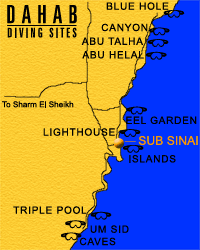
Irascible Dahab, a place with a spirit that can charm and frustrate within the same breath. It is located on the coast of the Gulf of Aqaba, and has retained its challenge against the eroding effects of institutional ways. Eroding in that one quickly learns about a sense of freedom that is lost in the west.
With the sun shining [about 364 days of the year], a cool wind blowing and the coffee being tasted as the waves lap just a meter away, it is hard to get too serious about time management, business schedules, and of course all the unspoken 'p' words such as 'plan', 'propose' and 'procedure' though 'probably' is ok.

This all happens in the northern part of Dahab called Masbat, where the camel still competes with the two-legged travelers, and each of the restaurants takes on its special character. To the south is the 5 star hotel areas, where those who need luxury can find it there. The Centre for Sinai on the other hand tends to promote accommodation of 1 billion stars and have our guests experiencing a difference in 'bedding', food and transportation that would not be found possible in other places. Dahab and its neighboring mountains and reef, is an antidote for the pressures of the technological age, try it!


Ahmed El-Sadek
Born in England in 1962, Ahmed has spent many years abroad, having spent this time in a variety of countries [Europe, Africa and America] as a result his father's profession. Because of this he is fluent in Arabic, English, and German and not too bad in French.


Though he started work in the tourism industry in 1979, he formalized his interest, graduating from Hotel Administration School in West Germany in 1984, then came to the Sinai for his first visit in 1985. Here he worked ever since as a desert guide, working with various travel agencies. Now with his own operation, started in 1993, he organizes camel and vehicle safaris and foot treks. Most of the time, he guides his customers on camel-back personally through the Sinai. These days I spend more time working on this site.

He has acquired much knowledge of the Sinai in many of its aspects: flora and fauna; history; and local culture. Based on this he has established the only comprehensive information center (CENTRE FOR SINAI) concerned with the Sinai and is available for anyone to visit, to read or simply to hear the stories over a glass of Bedouin tea. He has been gathering this information over a long period of time as there has been little work done in this regard by others.

He is conscious of environmental abuse especially through the tourist business and supports efforts by Bedouins in their attempt to bring about responsible attitudes towards keeping the Sinai habitat in good shape.(Sinai clean-up)

He eschews the stress of city life, preferring in its place the solitude and beauty of the desert, and is fascinated by the simplicity of the Bedouins, their lack of material possessions and their hospitality.

You can contact me directly at swelamahmed@hotmail.com


Seraye Abdullah Jabaly
...Bedouin - 56 years

Seraye was born in Bir Zreir in the mountains running along the east coast of the Gulf of Aqaba. When a young lad, he preferred to roam the hills and wadis, discovering the land he was to get to know best while learning the time honoured culture of the nomadic Bedouin. He met Ahmed in 1985 when Ahmed first arrived to the Sinai. He is Ahmed's trusted and faithful friend and vice versa.

He remembers when they would dry the dates and the fish, make charcoal and go on 1 month round trip to Suez to trade this for corn. The corn was then ground and mixed with goat's milk which was their daily diet for many months. The coastal Bedouin were better off than their mountain cousins as they had a virtual supermarket of reef fish on their doorstep - the coral reef of the Gulf of Aqaba.

Seraye spent most of the young adult years fishing and tending the family's date plot. When tourism


Ezzat Abdelmaguid

Of Sudanese origin, born in Cairo in 1958, Ezzat developed a passion for the country lifestyle especially now in the desert areas of Egypt. In the Sinai, he has found his home. Having lived for many years in the Sudan and traveled through America and Europe, he thought that the western lifestyle would make him forget the desert. But it was to the contrary. Anything that the materialistic world may provide is no compensation for the natural, simple life of the desert, its mountains and the sea


Lacking the taste for urban cities, he started to work as a desert guide in Sinai in 1985. He has lived there ever since. Now as a major contributor in CENTRE FOR SINAI, he specializes in mountain bike off-road safaris (his favorite), camel trekking, and foot trekking in the High Mountain Range and the Western Desert of Egypt

You can contact Ezzat directly at ezzat@centre4sinai.com.eg


Manshad Ibn El Salman
...Sinai Bedouin - 51 years

A man known for his smile and voice. Always on safari, Manshad entertains and teaches those with him the traditional Bedouin songs. His is extremely hospitable, forever making sure the comfort of the guest is considered. Though this rough warmth is ever present, he would not tolerate irresponsible acts by those trekking. He is well aware of the limitations of working with camels, and prepares things accordingly, making sure the riders stay together, that they don't get into a situation where they have not been properly prepared.

He runs several head of camel, one of the largest in Dahab. They are all well kept and of good temperament.

As a child he was living the life o2f a nomad with his mother, father and extended family. He was free to roam, to fish, and to learn the ways of the desert. He has seen this being slowly eaten away by the increasing presence of tourism in the area.

He's not sure when he was born, but we do know from an old-timer that there was a ship wrecked near Sharm el Sheikh, which would have been in 1950. From this we know he is now 51, not that it makes much of difference when you live this sort of a life.


Bassem Amer
...Egyptian - 30 years

Now a consultant for the National Parks of Egypt [having worked initially as a park ranger], for the South Sinai region, Bassem got to know the surrounding mountain areas well and the Bedouins who lived therein. With the benefit of this he now provides expert guiding services. He studied at the Alexandria University 1993 attaining a BSc [Botany] - he speaks Arabic, English, French and some Spanish.


He sees he has a responsibility for the maintenance of Bedouin culture and their surrounding environment by attracting quality tourism to the area. This includes camel safaris into areas to study the local plants, animals and geological formations. This can also be achieved by hiking treks into these parts, supported by the local Bedouins and guided by Bassem. In this way, the trekker can maximize his or her stay, by having someone on hand to explain in detail the various characteristics of those things discovered along the trail.

Being a painter, Bassem encourages other artists to come here to experience the grandeur of the Sinai, there to be inspired by it in producing their works. As a botanist, he has also accumulated significant knowledge in traditional Bedouin herbal medicine, and frequently speaks to the masters of this lore, working with them to develop and sustain this talent.


Eid Salim El-Atrash

Better known as Eddy or Zohar, to his friends, Eid was born on the afternoon of February 23rd 1973 in Ras Sudr, on the western coast of south Sinai. He is one of the very few Bedouins who actually know when they were born He belongs to the clan of El Gesar (the short ones) of the Tarabin tribe and grew up helping his father who traded between Ras Sudr, El Arish and Jordan.

They carried water melon seeds to El Arish and braught

cloth, rice, tea and coffee , back home. He grew up traveling the Sinai on camel-back and has developed more than casual interest in his surroundings and home

Today, he plays a major role in a study of Bedouin dialects and understands at least 17 of 26 different dialects of Bedouin Arabic spoken in Sinai

He is also in charge of our local excursion department and is a desert guide of top quality.

Working hard to make a living is his philosophy and while he was working hard in the mountains, two years ago, his only son, Selim, was kidnapped by his Hungarian mother to Hungary and he has not been allowed to see or speak to him on the phone ever since. He has also been denied the pleasure of receiving photographs of his kidnapped son. He fears his son will eventually be turned against by his hostile mother.

He is still working hard hoping he will soon see his son again but has not taken any legal action.

Contact Eid directly eddy@centre4sinai.com.eg

Clean Up Sinai Project

SINAI CLEAN-UP

Under the present conditions of mass development and mass tourism, it will not be long till the Sinai becomes an environmental disaster. Colorful plastic bags flying in the wind will overshadow the divine beauty of the landscape. The sweet smell of vermouth and other endemic plant-life of the mountains and valleys will be overpowered by the stench of accumulating garbage. Mt. Moses will become a monument to the ignorance, indifference, and stupidity of mankind.

The Egyptian Ministry of the Environment, with the help of the National Parks has been trying very hard to solve this problem organizing clean-up campaigns and trying to instill an awareness of the environment in the native population of Bedouins.

The Bedouins on the other hand have been waiting for the big flash floods for years, believing that the floods will carry the garbage away depositing it somewhere else; not that this would be a solution to the problem. We are still waiting for the great floods.

Still the problem is overwhelming. Mass construction of hotels is already ruining the landscape and I can’t think of any beach left on the Gulf of Aqaba that has not been sold, developed and devastated. This only increases the amount of ignorant tourists led by ignorant guides working for ignorant travel agencies who are only interested in making money, regardless of the damage they are causing.

Those of us who truly who come to enjoy everything that has made Sinai so special and care about the environment are doing our best to reverse these devastating effects by collecting any garbage we find while on safari, depositing it at specially designated centers in town.(ie HEMAYA in Nuweiba), where it is sorted out and transported out of Sinai to to the Nile Valley for recycling

CENTRE FOR SINAI also organizes groups of otherwise aimless youth to collect garbage in and around Dahab. This useful garbage thus provides useful income for its collectors.

But towns like Dahab, Nuweiba and Sharm el Sheikh at least have their local town councils who are supposed to be doing a good job for the money they are being paid. It is the interior of Sinai that needs all the help it can get. Who is responsible for the interior? It should be people like us, living, working and loving the Sinai as we do, who should be given a mandate by the government to take care of the job.

There are still many areas in Sinai which have not been designated as national parks. Not that it helps much to designate an area as a national park without setting up some kind of authority to implement the required guidelines. Even so, in the most famous of these (St. Catherine Nature Reserve), when the Bedouins plant their every once in a while crop of Cannabis in out of the reach mountainous areas, the Egyptian Army goes in to burn all these illegal plantations. The place is wasted.

Everything is burnt, (plastic irrigation hoses, cannabis plants, fertilizer) and is left there to rot. All this we collect when we find on our expeditions. The real shame is that indigenous plants like palm trees are also not spared the destruction. Small oases that have existed for thousands of years are sometimes burnt to the ground.

WHAT A GOD DAMNED SHAME!


How you can help:

Anyway, in an effort to make a difference and influence our environment in a positive manner, CENTRE FOR SINAI will operate any of our safaris in Sinai at almost cost price during the low season (April to September), for any interested group of people, the main goal being to collect garbage.

We will set up a schedule for these clean-up safaris during the summer. In the meantime, if you are on a very tight budget, wish to see the Sinai and don’t mind the summer heat, please don’t hesitate to contact us. We will be more than happy to help you help us clean our own beloved back-yard. 

Please Email: info@centre4sinai.com.eg 


Geology of Sinai 2

GEOLOGY

There are a few places only in the world where as a first-time visitor you are confronted with such a mountainscape as that of the Sinai. In the snaking wadis of the south and the looming, crafted vistas of the interior, the landscape is both visually overpowering and at peace - as if nature in enacting its script has become become frozen in stone.


The region was formed as a result of tectonic plate movement: the African, Arabian and Mediterranean shields pulling away from each other, creating a great gash in the land. At the same time, the outward movement pushed against existing rock layers forming the looming Sinai Mountains. The effect was extensive, extending from what is now the Jordan River valley, south, then south east, turning at Djibouti into Kenya - thus becoming known as the Great Rift Valley.


Two gulfs were created as branches to this valley. The Gulf of Suez leading to the Suez canal, is relatively shallow [60-90 metres] compared to the impressive depths of the Gulf of Aqaba. Here dropoffs can disappear alarmingly, descents being between 1000-2000 metres in some places.

The peninsula of Sinai can be divided into a northern and a southern region. The North consists of flat lying Palaeozoic [550 million years] and more recent sediments, while the South consists essentially of metamorphic and magmatic rocks which are of Precambrian age [more than 600 million years]. This southern portion is a continuation of the Arabio-Nubian Desert. A narrow belt [30kms wide] of soft Nubian sandstone also contains most of the Sinai minerals eg. turquoise, manganese, copper.

When traveling across the flat northern part, you can see to the south, below this sandstone belt, the granite mountains rising to peaks of more than 2,638 m [7,000 feet]. The metamorphic rocks in Sinai were last formed about a thousand million years ago. At that time along the southern portion of Sinai, a north-south belt of volcanic islands were active following their deposition in a great oceanic basin. As a result, large quantities of lava accumulated in this area at the same time as assorted sediments were deposited in adjoining basins due to erosion.

This resistant magmatic rock now occupies some 60% of the southern part of the peninsula and is responsible for the magnificent peaks [Gebel Serbal] and deepest canyons [Dahab]. There were several periods of intrusion and dyke swarms before a brief burst of younger volcanic activity, Musa and Catherine.

The more pastel colored granites are much older than the reddish rock. These dykes [fine grained basaltic intrusions], having pushed their way into the original coarse grained plutonic granites, created stunning effects of color and form. To this is added the effects of sandstone weathering and coloring through leeched minerals. In some places, a whole hillside is layered in all colors - red, purple, green, cream, white, orange. In many places the evidence of past geological activity is obvious with tilted layers sitting on the underlying granite base rock.

The central El Tih plateau of Sinai is virtually unpopulated, but at the foot of El Tih, to the south are the wide wadis. In rainy years they provide some pasture and are easier to traverse. Even today these sandy courses carry sufficient water below their surface to support a remarkable variety of life. Larger wadis, like Wadi Kid and the legendary Wadi Feran, are quite fertile in places, and a careful exploration of even the smallest of wadis will reveal surprising pockets of color. In fact, it is not uncommon during certain seasons for sudden storms to send floodwaters raging down the close-hewn channels of the coastal wadis - floods that bring in their wake an explosion of plant life.

PROTO-SINAITIC INSCRIPTIONS

PROTO-SINAITIC INSCRIPTIONS

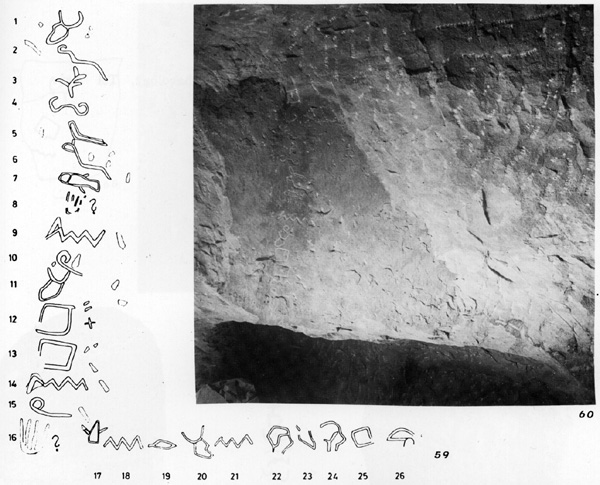
Proto-Sinaitic, also known as Proto-Canaanite was the first consonantal alphabet. Even a quick and cursory glance at its inventory of signs makes it very apparent of this script's Egyptian origin. Originally it was thought that the local West-Semitic population of Sinai aaround 1700 BCE, influenced by Egyptian culture had adopted a small number of hieroglyphic signs ( about 30 ) to write their own language. However, recent discoveries in mainland Egypt have compounded this scenario. Inscriptions dating to 1900 BCE written in what appears to be Proto-Sinaitic were found in Upper Egypt


Proto-Sinaitic soon spread to Canaan (Palestine), hence its other name, Proto-Canaanite, or old Canaanite script. It evolved locally into the Phoenician script which is its immediate descendant taking on a more linear ( less curved ) shape of its signs, everything else remained pretty much the same. South Arabian was also an early offshoot of Proto-Sinaitic, as its letters are very different in shape and order from Phoenician.

E.H. Palmer discovered the first Proto-Sinaitic inscriptions in 1869. Sir Flinders Petrie found about ten more in 1905 in the area of the temple of Serabit el Khadem. They were so called because they were found to pre-date the Nabataean inscriptions, which at that time had not yet been deciphered and were called the Sinaitic inscriptions

An inscription in one of the turquoise mines, the longest ever discovered, is a message from the leader of a certain mining group to one of the workers or his assistant. It reads: “Though, O Shaphan, collect from Ababa 8 minas “(of turquoise ). The signature is: “Shimea, groom of the chief of the caravaneers”.


Nawamis

NAWAMIS


They look like flattened igloos—mysterious ancient round burial tombs, called nawamis ,. To Canadian archaeologist Charles Currelly, who studied them in 1904 as part of British archaeologist Flinders Petrie's expedition to Sinai, these 6-foot-high sandstone structures resembled beehives scattered across the desert floor.


Their name, nawamis , Comes from Namus meaning mosquitos in Arabic. According to Bedouin legend, the nawamis were built as protection against mosquitoes by the Israelites of the Exodus during their wanderings in Sinai. The Bedouin also give the more likely explanation that the term namusiyeh (plural, nawamis ) refers to any separate or freestanding structure.


We simply use the word nawamis to refer to one or many of these unusual structures.

From the burial goods and human remains found in the nawamis , we know that they were built around 4,500 BCE as tombs by nomadic herders. These remarkably preserved stone buildings are thus the world's oldest remains of a pastoral nomadic society.


The bones in the nawamis were disarticulated (that is, separate from one another), which suggests that the tombs were used for secondary burials. Nomadic peoples did not always conveniently die near their burial grounds, and it would have been dangerous and unpleasant to transport decaying corpses over long distances. So the deceased would have been buried at the site of death and disinterred some time later for transport to the nawamis. The bones may well have been deliberately disarticulated for ease of transport.


Nine groups of nawamis have been discovered in southern Sinai, creating a kind of ring around Jebel Musa (Mt. Moses).


The people who built the nawamis would move seasonally with their herds of goats. In the heat of summer, they would climb high into the mountains to find pasture. During the bitterly cold winters, they would make their camps at lower altitudes. Most of the nawamis clusters are 2,400 to 3,000 feet above sea level.


Of the 42 nawamis near Ain Hudra, 30 are clustered on a low, flat hill. The others are scattered about the sandstone plateau. Each building is circular, about 12 feet in diameter (from outer wall to outer wall) and 6 feet high, with a small entrance facing thesetting sun in the west and a slightly concave roof.


All structures are well-built cylinders made from carefully selected, but not dressed, sandstone. The outer wall of each nawamis is built perpendicular to the ground. When the wall reached about 2 feet in height, the interior space was filled with gravel, and sometimes a floor of flat stone slabs was laid over the gravel. From this floor level, the outer wall was then continued straight up to the full height of the nawamis. An inner wall of stone slabs, abutting the outer wall, was built up from the gravel floor. This inner wall was constructed with a corbeling technique—so that each successive course of stone slabs jutted slightly more toward the center of the nawamis, eventually forming a partial interior dome. The opening at the top of this dome was then capped with a 3-foot-square slab of stone.

The outer wall of the nawamis rose 4 to 8 inches above the level of the capstone. The tomb builders then filled in any spaces between outer and inner walls with rubble, strengthening the structure and creating a shallow basin-shaped roof. The finished tomb—with its solid, finely constructed outer wall, its lovely circular shape and its spare desert surroundings—is an impressive monument for the dead.


This corbeling technique is well known from later periods. The founder of Egypt's 4th Dynasty, Sneferu (2575-2551 B.C.), built the first Egyptian corbeled chamber in his North Pyramid at Dahshur, at the southern end of the Memphis necropolis. The nawamis are at least 500 years older than the North Pyramid; they thus provide some of the world's earliest known examples of the use of corbeling, along with the roughly contemporaneous megalithic temples on the island of Malta. No doubt the lack of wood in the desert motivated the nomads of Sinai to develop this elegant roofing solution.


Each nawamis has a small rectangular entrance, about 2 feet high and 1 foot wide, always facing west towards the setting sun which suggests an Egyptian origin for these ancient nomads. The entrances were probably sealed with a blocking stone, though no sealed nawamis were found. These stones were likely removed in later times, either by grave robbers or by Bedouin who simply wanted to use the nawamis as tombs (one nawamis contained a skeleton that was less than 100 years old).


We are even able to suggest, from the apparent motion of the sun, the months when the nomads built their burial structures The sun travels about 23 degrees north to south along the western horizon during the year—being farthest north at the summer solstice and farthest south at the winter solstice. In 80 percent of the nawamis , the entrances were oriented toward the setting sun of July or August.

How do we date these enigmatic structures? The answer lies in the objects buried with the disarticulated bones in the nawamis. The task is made difficult by the fact that each of the 24 structures which were examinied had been disturbed in antiquity. This means that our dates for the nawamis remain somewhat speculative. To fix the dates of the tombs with certainty, we would need to find an undisturbed, sealed nawamis . Nonetheless, by sieving the sand and rubble inside the structures, evidence was found to date them to the 4 th millennium B.C.


The most numerous artifacts were necklace beads made from marine shells, fish teeth, carnelian, bone, ostrich shells and faience—the latter made from glazed pottery, probably acquired from mainland Egypt by the nawamis builders. The most common bead by far was made from dentalium, a mollusk with a tapering tubular shell (often called a tooth shell), found in the Red Sea.

In a third of the nawamis , shell bracelets were found that had been cut from the mollusk Lambis truncata. This Red Sea mollusk, also known as the Giant Spider Conch, grows to as large as 16 inches long and 8 inches wide. Lambis bracelets are known from the Chalcolithic period (c. 4500-3500 B.C.) site of Tell Abu Matar, near Beer-Sheva, Israel, and from the Chalcolithic/Early Bronze sites (late fourth millennium B.C.) of Bab edh-Dhra in Jordan and Tell el-Farah (North) on the West Bank of Palestine Thus our Lambis bracelets provide a rough chronological indicator for dating the nawamis to the fourth millennium B.C.

Support for this date also comes from about 100 flint transverse arrowheads found in most of the nawamis that were studied. Unlike the more familiar arrowhead whose point forms the end of the projectile, transverse arrowheads are “backward”—with the point of the triangular arrowhead attached to the arrow's shaft and the wide edge of the arrowhead forming the end of the projectile. These arrowheads are quite common at sites in the Egyptian Delta, the Mediterranean coast of Egypt, Sinai and southern Palestine—and they all date to the fourth millennium B.C. Transverse arrowheads are also depicted in early Egyptian art, such as on the Hunter's Palette (also called the Lion Hunt Palette) from the late pre-dynastic period (c. 3000 B.C.). Today transverse arrowheads are sometimes used to hunt small birds, in order to disable but not kill the creatures.

To test the fourth-millennium B.C. date provided by the Lambis bracelets and transverse arrowheads, radiocarbon tests were performed on the scant organic finds. Charcoal found in the nawamis gave a carbon date of the fourth millennium B.C.

Life was harsh and relentlessly demanding for these herders, who moved from place to place constantly searching for grazing land for their goats. Why did they bury hard-to-come-by goods—even valuable copper arrowheads—with the dead rather than pass them on to the living? Clearly they believed that the dead needed their beads, bracelets and arrowheads in the afterlife, further proof of an Egyptian origin for these people

We would later see this belief in an afterlife fully developed in pharaonic Egypt. Egyptian burial practices resembled those of the nawamis , especially in their orientation toward the setting sun. The west, in Egyptian belief, was the land of the dead, where every evening the sun “died,” only to be “reborn” in the morning in the east. Even in pre-dynastic Egypt (last centuries of the fourth millennium B.C.), bodies were laid to rest in burial pits with their heads facing west.

.The nawamis culture was a flash in historical time, lasting only about 300 years. When the Egyptians began to build the great pyramids in the mid-third millennium B.C., the nomads who buried their dead in strange stone desert huts had already lived out their history—or at least what we know of it. The pyramids, with all their grandeur and majesty, seem built for eternity. What is astonishing is that the small, modest stone structures in Sinai also still stand strong in the battle against leveling time.
http://www.centre4sinai.com.eg/nawamis.htm

Historical Timeline of Sinai Part 13

Late Paleolithic Age: 32,000 BC – 28,000 BC

We don’t even have a name for the people who inhabited the Sinai Peninsula at this time, but they lived in northern Sinai in the barren hills around Jebel Maghara and Jebel el Lagama not far from such rich water sources as Bir el Gafgafa. They continued to inhabit the area until the Epipaleolithic period which lasted until about 8000 BC.

Many of these nomad’s old campsites were discovered where they left their surprisingly sophisticated flint implements. Most were scrapers and knives. But archaeologists also found tiny rectangular or trapezoidal blades also known as “microliths” which could have been mounted end to end in a wooden shaft, long since decayed, of course. The result would have been a large cutting tool like a sickle. From their tools and the remains of their settlements, we can see that they were nomadic groups of hunters and food gatherers who encamped in small groups of not more than 100 or so people.

Historical Timeline of Sinai Part 12

Neolithic Preceramic B: 8,000 BC – 5,500 BC

The earliest evidence of expansion from Egypt proper is from the period known as “Neolithic Preceramic B” These newcomers who came from Egypt settled in southern Sinai. Some of the dwellings of these Neolithic people have survived. A typical settlement lies in the Wadi Tbeig, about 40 km north of St. Catherine’s. The settlement covers about 750 sq. feet and consists of more than 20 interconnected circular structures built of unworked stone blocks. Some of these building blocks are quite large, in several case over 10 feet round.

The excavators concluded from the amount of rubble in the debris, that the stone portions of the wall were fairly low. The upper parts of the walls and the roofs must have been constructed of lighter materials such as mud brick and mud plastered branches. The dwellings had doorsills of flat stone slabs and fire pits with hearths. Grinding stones, stone bowls, Red Sea shells, a few goat bones and a large variety of flints, including arrowheads, awls, drills, scrapers and various types of blades were found in the houses.

At “Ugrat el Mihad”, a few kilometers north of Jebel Katrin, excavators found the same assemblage, but they did not find the same kind of dwellings. Instead, they uncovered 6 large oval shaped structures, which we assume were roofed since the remains of the walls were very low and there was enough stone rubble around them to imagine that they ever stood much higher. These floors were paved. Perhaps these structures were sunken storage silos.

Historical Timeline of Sinai Part 11

Neolithic Preceramic B: 8,000 BC – 5,500 BC

The earliest evidence of expansion from Egypt proper is from the period known as “Neolithic Preceramic B” These newcomers who came from Egypt settled in southern Sinai. Some of the dwellings of these Neolithic people have survived. A typical settlement lies in the Wadi Tbeig, about 40 km north of St. Catherine’s. The settlement covers about 750 sq. feet and consists of more than 20 interconnected circular structures built of unworked stone blocks. Some of these building blocks are quite large, in several case over 10 feet round.

The excavators concluded from the amount of rubble in the debris, that the stone portions of the wall were fairly low. The upper parts of the walls and the roofs must have been constructed of lighter materials such as mud brick and mud plastered branches. The dwellings had doorsills of flat stone slabs and fire pits with hearths. Grinding stones, stone bowls, Red Sea shells, a few goat bones and a large variety of flints, including arrowheads, awls, drills, scrapers and various types of blades were found in the houses.

At “Ugrat el Mihad”, a few kilometers north of Jebel Katrin, excavators found the same assemblage, but they did not find the same kind of dwellings. Instead, they uncovered 6 large oval shaped structures, which we assume were roofed since the remains of the walls were very low and there was enough stone rubble around them to imagine that they ever stood much higher. These floors were paved. Perhaps these structures were sunken storage silos.

Historical Timeline of Sinai Part 10

The Chalcolithic Age: 4,000 BC

Archaeologists know the 4th millennium BC as the Chalcolithic Age. Etymologically, the name refers to the copper widely used by these people who lived more than 5000 years ago. In Sinai however, it was not copper that these people were mining but the rich veins of turquoise in the southwestern sector of the peninsula.

In Palestine the Chalcolithic period is often referred to as the Ghassulian culture, after the site of Ghassul in the Jordan valley where this culture was first identified. The Ghassulians from the Chalcolithic period have now been identified in several sites in northern Sinai. A survey found over 700 ancient sites from all periods strung along the main routes between Egypt proper and Canaan, in the area between Rafah and the Suez Canal in northern Sinai. Over 100 of these sites included remains from the Ghassulian culture of the 4th millennium BC.

At none of these sites were any architectural remains uncovered. The pottery sherds that dated the sites and the occupational levels were typical of temporary encampments and may have been wayside stations between Egypt and Canaan. Ghassulian culture in Sinai was confined almost exclusively to the northern coast with one interesting exception. At the foot of Mt. Serabit el Khadem, a small Ghassulian settlement was discovered. It turned out to be a work camp for miners of the famous turquoise mines of Serabit. In and around this small chalcolithic site, we found unpolished gems, hematite hammers to quarry the turquoise bearing blocks of sandstone, flint blades to extract the turquoise nodules, grinding stones to polish the gems and large quantities of Ghassulian pottery.


Another Phenomenon that belongs to the same chronological period but not to the same culture are the Nawamis. These are beehive shaped structures built of sandstone slabs or metamorphic cobbles. Found only in southern and eastern Sinai, they appear to have been built in clusters, each cluster lying several kilometers from its nearest neighbour. Each Nawamis is about 10 and 20 feet in diameter and approximately 7 feet high. Their walls curve inward towards the top to form a corbelled roof supported by a large stone slab.
Many of these roofs are still intact. They are burial structures for members of the same family or clan. Some burials are primary ones and others are secondary. The funeral offerings in the Nawamis included shell bracelets, faience beeds, flint tools, juglets and tools made of bone and copper all reflecting contact with both Egypt and Canaan. We found 2 juglets from the Naqada I period which is parallel to the late Chalcolithic period (3,400 BC – 3,150 BC).

Each Nawamis has a small entrance constructed of upright slabs facing the setting sun. These people probably shared the Egyptian belief that the soul journeys to the west after death. This strengthens the possibility of an Egyptian origin for these people. They had a highly developed culture and were able to construct these architecturally sophisticated Nawamis, which could not be the work of desert tribes

Historical Timeline of Sinai Part 9

Early Bronze Age: 3,150 BC – 2,200 BC

The early Bronze Age witnessed a population explosion all over the near East. This occurred in Sinai as well specially in the southern part of the peninsula and the northern coastal strip. EB 1, which corresponds to the proto-dynastic period in Egypt proper, is represented by small-unfortified settlements along the northern coast of the Sinai. An expedition collected both Egyptian and Canaanitic pottery in these small settlements which marked the route between Egypt and Canaan. The only other EB 1 settlement in south Sinai is 50 kilometres east of Ras Sudr.

From the EB 2 Age, a whole series of settlements were discovered of whom only 6 were excavated, all in the massive granite mountains in the heart of the peninsula. They consist of the same type of one room houses built in Canaan in the EB 2 period, which were abundant in Arad, a large city in the Negev desert.

In every site that was excavated, we found lumps of copper and casting moulds, which is evidence of copper production. These sites lie very close to the ancient copper mines

Egypt and Sinai had up till now shared cultural similarities and the peoples of these areas mingled freely. It was after the establishment of the Egyptian Dynastic Kingdom that Egyptian interest in Sinai grew around 2,650 BC. What attracted the Egyptians was not copper but turquoise. There is no doubt about the strong Egyptian presence because the mining expeditions left a lot of evidence behind and it is still there. Of special interest are the many stone reliefs and inscriptions that provide a secure dating for the Egyptian mining activity. One curious discovery was the relief of Pharoa Sekhemkhet (3rd Dynasty) carved on one of the high cliffs of Wadi Maghara.

During the Middle Kingdom, in the 12th Dynasty (1,991 BC – 1,786 BC), the Egyptian Pharaohs moved their turquoise mining operations to the rich veins of Serabit el Khadem in west central Sinai. They continued to operate these mines for 8 centuries thereafter, during the New Kingdom and up to the reign of Ramses VI. At Serabit, the Egyptians left some of the most magnificent ruins in all of Sinai. On a mountain plateau, they built a temple dedicated to the goddess Hathor who among her other epithets was known as “Lady of Turquoise” and “Mistress of the Far Lands”. This was one of only 2 ancient Egyptian temples outside the Egypt proper, the second, also dedicated to Hathor, at the ancient Egyptian copper mines in Wadi Timna in Palestine (modern state of Israel). It is starting of this era, that the Sinai is regarded as an integeral part of the Egyptian Kingdom, not only because of the Egyptian mining activities, but because the Sinai is Egypt’s eastern buffer zone. North Sinai has already been settled by Egyptians.

Historical Timeline of Sinai Part 8

Early Bronze Age: 3,150 BC – 2,200 BC

The early Bronze Age witnessed a population explosion all over the near East. This occurred in Sinai as well specially in the southern part of the peninsula and the northern coastal strip. EB 1, which corresponds to the proto-dynastic period in Egypt proper, is represented by small-unfortified settlements along the northern coast of the Sinai. An expedition collected both Egyptian and Canaanitic pottery in these small settlements which marked the route between Egypt and Canaan. The only other EB 1 settlement in south Sinai is 50 kilometres east of Ras Sudr.

From the EB 2 Age, a whole series of settlements were discovered of whom only 6 were excavated, all in the massive granite mountains in the heart of the peninsula. They consist of the same type of one room houses built in Canaan in the EB 2 period, which were abundant in Arad, a large city in the Negev desert.

In every site that was excavated, we found lumps of copper and casting moulds, which is evidence of copper production. These sites lie very close to the ancient copper mines

Egypt and Sinai had up till now shared cultural similarities and the peoples of these areas mingled freely. It was after the establishment of the Egyptian Dynastic Kingdom that Egyptian interest in Sinai grew around 2,650 BC. What attracted the Egyptians was not copper but turquoise. There is no doubt about the strong Egyptian presence because the mining expeditions left a lot of evidence behind and it is still there. Of special interest are the many stone reliefs and inscriptions that provide a secure dating for the Egyptian mining activity. One curious discovery was the relief of Pharoa Sekhemkhet (3rd Dynasty) carved on one of the high cliffs of Wadi Maghara.

During the Middle Kingdom, in the 12th Dynasty (1,991 BC – 1,786 BC), the Egyptian Pharaohs moved their turquoise mining operations to the rich veins of Serabit el Khadem in west central Sinai. They continued to operate these mines for 8 centuries thereafter, during the New Kingdom and up to the reign of Ramses VI. At Serabit, the Egyptians left some of the most magnificent ruins in all of Sinai. On a mountain plateau, they built a temple dedicated to the goddess Hathor who among her other epithets was known as “Lady of Turquoise” and “Mistress of the Far Lands”. This was one of only 2 ancient Egyptian temples outside the Egypt proper, the second, also dedicated to Hathor, at the ancient Egyptian copper mines in Wadi Timna in Palestine (modern state of Israel). It is starting of this era, that the Sinai is regarded as an integeral part of the Egyptian Kingdom, not only because of the Egyptian mining activities, but because the Sinai is Egypt’s eastern buffer zone. North Sinai has already been settled by Egyptians.

Historical Timeline of Sinai Part 7

Middle Bronze Age: Middle Bronze Age: 2,200 BC – 2,000 BC

Many MB 1 settlements were found in the Negev highlands in southern Canaan and traces of such settlements have also been found in northern Sinai. It is suggested that MB 1 settlers came out of Sinai and migrated to Canaan.


Late Bronze Age: 1,550 BC – 1,200 BC

It was during the extensive mining activities of the Egyptians in Sinai that the so-called Proto Sinaitic script was invented. These inscriptions, discovered by E.H. Palmer in 1869, are written in an alphabetic script-invented under hieroglyphic influence. The script represents the earliest form of the Semitic alphabet, from which all modern alphabets are derived.

Egyptian or Asiatic workers of the mines attached to the Egyptian mining expedition as free men undoubtedly wrote the inscriptions. This alphabet, although very closely related to Egyptian hieroglyphs, was nevertheless a departure from the complicated system, the Egyptian Court used in writing its language. This was probably the script of the normal person. In and around Serabit el Khadem, discoveries were made useful in dating these inscriptions to the late 16th and early15th centuries BC, although recent discoveries of the same script in Egypt’s Eastern Desert have been dated to the 18th century BC.

Many MB 1 settlements were found in the Negev highlands in southern Canaan and traces of such settlements have also been found in northern Sinai. It is suggested that MB 1 settlers came out of Sinai and migrated to Canaan.


Late Bronze Age: 1,550 BC – 1,200 BC

It was during the extensive mining activities of the Egyptians in Sinai that the so-called Proto Sinaitic script was invented. These inscriptions, discovered by E.H. Palmer in 1869, are written in an alphabetic script-invented under hieroglyphic influence. The script represents the earliest form of the Semitic alphabet, from which all modern alphabets are derived.

Egyptian or Asiatic workers of the mines attached to the Egyptian mining expedition as free men undoubtedly wrote the inscriptions. This alphabet, although very closely related to Egyptian hieroglyphs, was nevertheless a departure from the complicated system, the Egyptian Court used in writing its language. This was probably the script of the normal person. In and around Serabit el Khadem, discoveries were made useful in dating these inscriptions to the late 16th and early15th centuries BC, although recent discoveries of the same script in Egypt’s Eastern Desert have been dated to the 18th century BC.

Historical Timeline of Sinai Part 6

EXODUS: 1450 – 1250 BC

The exact date of the Exodus of the Israelites from Egypt and their 40 years of wandering the Wilderness of Sinai is not known. There have been many theories but “Nowhere in the Sinai” says Professor Rothenberg of Tel Aviv University, “did we or our colleagues find any concrete remains of the stations on the Exodus routes, nor even small encampments that could be attributed to the relevant period. Neither did we discover anything that would help us identify the Mountain of God”.

Some scholars attribute the lack of archaeological evidence of the Israelites in Sinai to the theory that the vessels were made of wood, leather, gourds or other perishable materials. Others suggest that the stations on the Exodus route mentioned in the Bible have been either covered and obliterated by the desert sands or washed away by erosion. We find it difficult to accept these arguments, because there are thousands of ancient sites in Sinai predating the Exodus. The notion that the Israelites had only vessels of perishable materials during their 40 years of wandering is most unlikely.

Historical Timeline of Sinai Part 5

Persian, Hellenistic and Roman Ages

Settlements from the Persian (520 – 332 BC), Hellenistic (332 – 37 BC) and Roman (37 BC – 324 AD) have long been known on the ancient highway from the eastern delta along the northern coast . Expeditions excavated some of these sights, including a large, fortified Egyptian enclosure south of Pelusium that dates to the 6th century BC. The many Greek vessels found in the fort testify to an occupation by a Greek population under the aegis of the Egyptian monarchs of the 26th Dynasty.

The Persian conquest of Egypt in 525 BC is reflected in settlements, caravansaries and cemeteries along the coast. Finds confirm historical sources that describe the prosperity of the region during Persian and Hellenistic times due in no small part to the reciprocal trade between Egypt and her neighbors.

Among the early Roman sites discovered were a number of Nabataean cities. The Nabataeans were famous merchants who controlled the incense and spice traffic at the time. The largest and most important of their cities on the Mediterraneun coast of Sinai was Qassarwit, where a series of most impressive Nabataean temples were uncovered.

Historical Timeline of Sinai Part 4

The Byzantine Period

In the Byzantine period, the center of action returned to southern Sinai especially around Jebel Musa and the oasis in Wadi Feran – where from the 4th century AD on, pilgrims sought out sacred sites in the mountains.

This area became a centre of Byzantine monasticism. In the 6th century, St. Catherine's Monastery was built by Emperor Justinian at the foot of Jebel Musa, not to mention the ruins of chapels and churches in Wadi Feran (4th & 5th centuries) which was the center of the Christian community in the Sinai until the invasion of the Arabs with Islam in the 7th century.h

Historical Timeline of Sinai Part 3

The Arab Conquest of Egypt

Salah El Din El Ayoubi (Saladin)

The Suez Canal

In 1831 Ferdinand de Lesseps (1805-94) came to Cairo as a young consular student, and there had his attention called to Lepere’s memoire regarding the scheme of connecting the two seas, which led him to consider its great importance in spite of Lepere’s doubts as to its feasibility. In 1838 he made the acquaintance of Lieut. Waghorn, whose zealous advocacy of the establishment of a route between Europe and India via Egypt stimulated his zeal for a similar project. In 1841 and 1847 Linant Bey and Robert Stephenson, Alois von Negrelli, the Austrian, and Bourdaloue, the Frenchman, demonstrated the inaccuracy of Lepere’s calculations. In 1854 De Lesseps, having matured his plan, laid it before Said Pasha, who was the viceroy and determined to carry it out. Difficulties were thrown in the way of the enterprise by the British government during Lord Palmerstons ministry, but on Jan. 5th 1856, permission to begin the work was formally granted by the viceroy. A considerable time, however, elapsed before the necessary capital was raised, and it was not till April 25th 1859, that the work was actually begun. The viceroy undertook to pay many of the current expenses and provided 25,000 workmen, who were to be paid and fed by the company at an inexpensive rate and were to be relieved every three months.

On March 18th 1869, the water of the Mediterranean was at length allowed to flow into the nearly dry, salt encrusted basins of the Bitter Lakes, the northern part of which lay 26-40 ft. below the level of the Mediterranean, while the southern parts required extensive dredging operations. The opening of the Suez Canal was inaugurated on Nov. 17th 1869, with magnificent festivities in the presence of the Empress Eugenie and many European princes. 100,000 Egyptian workmen lost their lives during the undertaking.

Said also gave De Lesseps a number of undertakings about the supply of labour and purchase of shares which were to be financially disastrous for Egypt. The British government pressed the Ottoman Sultan to invalidate the concession obtained by De Lesseps from Said Pasha which entitled the Universal Suez Canal Company to dig the canal and operate it for 99 years (largely because it was under French direction) and a new concession had to be obtained in 1856. Ismail tried to modify the concession when he came to power in 1863, placing more responsibility on the company to provide the labour promised by Said. In the end Egypt paid almost 70 % of the 19 million sterling pounds cost of the canal and received 15 % of its profits.

In 1875, Lord Beaconsfeld, on behalf of the British Government, acquired 176,602 of the Khedives shares for a sum of 4,080,000 pounds sterling and nearly one half of the shares became in British hands. Up to its nationalisation in July 1956 by President Gamal Abdelnasser, the canal used to belong to the Suez Canal Co. (Compagnie Universelle du Canal Maritime de Suez), founded in 1854, which possessed also lands, buildings, and other properties, valued in 1929 at nearly 3,000,000 pounds sterling. Its concession should have expired in 1968. It was replaced by the Suez Canal Authority in 1957.

Historical Timeline of Sinai Part 2

20th century Sinai

The History of Sinai as of the 20th century is directly related to the events of the Middle East , beginning with the Zionist movement which began by slowly migrating Jews from Russia and Eastern Europe to their presumed God-given homeland, Palestine . Prior to that it was a long phase of peace and quiet with the exception of internal squabbling between the local Bedouin tribes.

Sinai’s north-eastern neighbor, Palestine and its population of Palestinians unknowingly became the subject of a scheme based on the premise that the Palestinian people did not even exist, ( A land without a people for a people without a land). Foreigners began coming to Palestine en masse to settle in the country, which in the beginning was met with little resistance from the Palestinian people. Later, it became more and more clear that those foreign Zionist immigrants claimed that the land belonged to them, as it had belonged to Jews thousands of years ago

The start of Jewish immigration into Palestine was followed by the First World War, the British occupation of Palestine, which ended Ottoman rule, the Balfour Declaration and the mandate of League of Nations, which aimed, inter alia, at the establishment of a Jewish homeland in Palestine in total disregard of the Covenant of the League and the rights of the Palestinian people. Then came the Second World War and the presumed Holocaust against the Jews in Europe, which was followed by the adoption of General Assembly resolution 181, partitioning Palestine into a Jewish State and an Arab State, with Jerusalem as corpus separatum (under an international regime). Despite the fact that the Jewish settlers owned only 6 % of the total land of Palestine and Jews constituted one third of its population, the European dominated United Nations recommended the partitioning of Palestine between Arabs and Jews. The plan entailed the alienation of 56 per cent of the land of Palestine to the would- be Jewish state whose population was to include 45 per cent Arabs.

For these reasons the Palestinians rejected the inequitable Partition Plan. On the other hand, the Zionists sought to expand over the area allotted to them by the plan. In the ensuing conflict between Palestinians and Zionists , the latter’s armed forces effected the occupation of about 80 per cent of Palestine prior to the termination of the British Mandate on 15th May 1948 and before the entry into Palestine of any Arab army. More tragic was the expulsion of nearly 3 or 4 million Palestinian Arabs from their lands and country. Their numbers were later swollen by further expulsions

Ultimately the Palestinian people became the ones to pay the tragic price for the crimes committed against the Jews in Nazi dominated Europe. The Palestinian people themselves became the victims of another crime in history. Their entire society was destroyed, with many fleeing to surrounding countries with the establishment of the rogue , racist Zionazi , terrorist State of Israel in 1948 and the Arab-Israeli war that ensued. For years to follow, the threat to the national identity of the Palestinian people was ever present, and the potential for regaining their rights was the target of continuous opposition. The Palestinians remember what Jews in Israel call the War of Independence as El Nakba, meaning the catastrophe. The day they lost their homeland

This was the beginning of a new age of turbulent turmoil for the whole of the Arab World and its neighbors. The creation of the state of Israel will go down as an infamous day for all humanity in the history books of the future.

Nationalisation of the Suez Canal

On 23rd July 1952, Gamal Abdel Nasser and his group of free officers, dissatisfied with the corruption of the king Farouk regime and the British occupation overthrew the regime in a bloodless coup. On July 26th, King Farouk left Alexandria on his personal Yacht never to return to Egypt again. His toddler son, Ahmed Fouad was declared king. The remaining British troops were asked to leave the country and by 1954, the last British soldier had indeed left. The Free Officers gradually engaged in politics during the following years. In 1953, they deposed Ahmed Fouad, the last King, and declared Egypt a Republic with Mohamed Naguib as its first president. Naguib who grew up within the old system, was a courageous yet peaceful man and had no plans for radical change, so he too was deposed and in 1954, the true leader of the coup, Nasser, became the country’s head of state.

Nasser achieved unprecedented popularity throughout the Arab world. He was admired for his rousing support of Arab Nationalism; his domestic social programs, for the first time in Egypt’s history, sought to better the lot of the peasant majority. He announced an aggressive development program in 1952 for which he was lobbying for funds around the world. He started by raising funds mainly through the U.N., World Bank and the western democratic nations and soon sought the assistance of communist nations. It was his aim, and for the benefit of the country, to build a huge dam at Egypt’s southern frontier, to regulate the flow of the Nile and thereby modernize the Egyptian agricultural system, which flooded all of Egypt for a third of every year taking lives, destroying properties and rendering all agricultural land unusable. When an arms deal with Czechoslovakia went through, US Secretary of State John Dulles announced withdrawal of US funds and assistance for Nasser’s development program. The World Bank followed suite. In response to the harsh treatment of Egypt by the western World, Nasser nationalized the Suez Canal on July 26th, 1956.

The nationalization of the canal took the world by surprise, especially the British and French stockholders who owned the Suez Canal Company. Although Nasser promised that the company would be compensated for its loss, Britain, France and Israel began plotting to take back the canal, occupy the Sinai Peninsula and overthrow Nasser. Britain, France and Israel united in secret in what was to become known as the tripartite collusion, something they denied publicly for many years. Israel opted to participate in the plans against Egypt in order to gain favor in the sight of western nations and to further it’s own plans of a greater Israel from the Nile to the Euphrates.

The Tripartite Agression (Suez War) 1956

In collusion with Britain and France in 1956, Israel invaded the Sinai Peninsula and reached the Suez Canal, while British and French troops were being prepared to invade Egypt proper and dislodge the national reformist regime. The Tripartite invasion was condemned by the United Nations and the United Sates, and the aggressive forces were made to withdraw. But out of this aggression, Israel gained access to the Gulf of Aqaba and occupied the Sinai Peninsula for the first time. It was returned after a couple of months to the deep sorrow of the Israelis

Arrangements were made for Israel to make the initial invasion of Egypt and overtake the Sinai and one side of the canal on 29th October 1956. The British and French attempted to follow the Israeli invasion with diplomacy for one whole day, but were unsuccessful, and the following day on 30th October, sent in troops to occupy the other side of the canal. The actions of the tripartite collusion were not viewed in favor by the US or the Soviet Union since their intervention signified their predominance in the area. The United States opposed this action as a violation of the principle of self-determination. The American delegation to the United Nations voted in favor of a General Assembly Resolution calling for an immediate cease-fire and the withdrawal of the invading troops. Great Britain, France and Israel finally accepted these terms.

In March 1957, under the supervision of a U.N. police force, the Suez Canal was cleared of wreckage and opened to shipping. The canal was returned to Egypt, and reparations were paid by Egypt under the supervision of the World Bank. After 86 years, the canal was at last returned to its rightful owners, the Egyptians, who operated it and continued to develop it according to the needs of world shipping. Overall the actions of Britain and France served to draw Nasser and Egypt into further relations with the USSR. The fight for the canal also laid the groundwork for the Six-Day War in 1967 due to the lack of a peace settlement and the unfulfilled Zionist dream of a greater Israel.

The Six Day War 1967

The crisis of the spring of 1967 originated with border confrontations between Israel and Syria, arising from Israeli encroachments on Arab owned lands in the demilitarized zones as demarcated in the 1949 Syrian-Israeli Armistice Agreement. Israeli threats against Syria and the concentration of troops on the border evoked Egypt’s response in the form of a military build-up in Sinai, and Cairo assured both Washington and Moscow that it would not start war against Israel. Counter assurances were transmitted by Washington and President Johnson reiterated U.S. support of” the territorial integrity’ of all the Middle East states, Diplomacy appeared capable of resolving the crisis, when

On the morning of June the 5th, Israel’s Air Force; launched a Pearl Harbor-type sneak attack on Arab air bases, destroying the bulk of Arab planes on the ground. Systematic land blitzkriegs followed, resulting in Israel’s swift victory. Lebensraum, Hitler-style was achieved by the Zionist state as Arab territories more than three times the area of Israel came under her occupation. As a result, Israel then occupied all Palestine whose entire population became either in exile or under Israeli rule

On November 22nd 1967, the UN Security Council unanimously adopted Resolution 242 based on the following principles: Withdrawal of Israeli armed forces from territories occupied in the 1967 conflict, termination of all claims or states of belligerency and respect for an acknowledgement of the sovereignty, territorial integrity and political independence of every state in the area, freedom of navigation in international waterways and a just settlement of the refugee problem, Significantly, the Preamble of the Resolution emphasized a basic principle of international behavior, namely ,the inadmissibility of acquisition of territory by war. The resolution called for a designation of a mediator to promote agreement leading to a peaceful settlement on the basis of the above principles. The resolution did not call for direct negotiations.

Prelude to the 1973 October War

While the Arabs accepted the UN peace plan unconditionally, Israel qualified her interpretation and blocked its implementation. In violation of several U.N. resolutions, Israel annexed Arab Jerusalem and began settling the Golan Heights of Syria, the West Bank of Jordan, The Gaza Strip and Sinai. Israeli leaders have repeatedly declared the “non-negotiability” of the status of Jerusalem, the Golan Heights, Sharm el Sheikh and even the Gaza Strip. And have refused to recognize the right of the Palestinians to return to their home

Ambassador Gunnar Jarring who was designated as the mediator by the United Nations failed in his mission because of Israel’s insistence on direct negotiation and her own interpretation pf “secure and recognized boundaries”. Her insistence on direct negotiations was simply an alibi to to hold on to the occupied territories. Other efforts made by the Superpowers and other Western countries as well as by African states have all failed because of Israel’s rejection of the principles of peace agreed upon by the United Nations.

For six years, the Arabs endured an intolerable situation, waiting patiently for an ever -elusive peace based on the provisions of Resolution 242.Meanwhile some western countries, particularly the United States, having succeeded in establishing a ceasefire along the Suez Canal, thought they could let well enough alone and allow a seemingly quiet situation to continue indefinitely. To the Arab countries, however, the ceasefire was not an end in itself. They were convinced that war was inevitable as long as Israel continued to occupy their territories and to deny the Palestinians their inalienable right of self-determination, To avoid this eventuality, in the summer of 1973, Egypt made a final effort based on the unanimously accepted Security Council Resolution 242, to reach a just settlement. Once more the Arabs were faced with an American veto- the U.S. was the only member of the Security Council, which supported the Israeli position

The 6th October war ( 10th of Ramadan, Yom Kippur ) 1973

On October 5th 1973 Egypt and Syria responded to several provocations with a full-scale counter attack across the Suez Canal and the Golan ceasefire line. The Arab states waged their October battles to recover their lands occupied militarily by Israel since 1967 and hoped that the world community would exert its pressure to bring about an enduring peace based on justice for all states and for the restoration of the legitimate rights of the Palestinian people. This was a battle to achieve a just peace in the region

Despite the fact that the Arabs had made it perfectly clear that their aim was the liberation of their occupied lands and not the destruction o Israel, The U.S. chose to escalate her support of military assistance to Israel, even at the cost of precipitating a crisis with its European allies. Had it not been for the massive U.S. airlift of supplies, which started as early as October 7th, and her prompt and astronomical financial aid to Israel, the outcome of the war would have been very different. The Arab’s response was an oil cutoff to the U.S. and those countries, which supported Israeli expansionism.

The war demonstrated the fallacy of Israel’s contention that she needed to retain Arab territory for reasons of security. With such advanced technology, there is no geographically secure border. It took Egypt 6 hours to overrun the BarLev Line and the Syrians overran most of the Golan in the early hours of the war.

In January and May 1974, disengagement agreements were reached between Egypt and Israel and Syria. U.S. Secretary of State, Henry Kissinger continued to exert efforts to reach further agreements, which would lead to Israeli withdrawal from occupied Arab lands and lay the foundations for mutual security. In October 1974, the United Nations recognized the Palestine Liberation organization (PLO) as the sole legitimate representative of the Palestinian People and endorsed the Palestinian right to independence and statehood.

The Peace Process and Accords

On 17 September 1978, Israel and Egypt signed two agreements, the first between Israel and any of its Arab neighbors. The Camp David Accords were negotiated by the Israeli prime minister Menachem Begin and the Egyptian president Anwar Sadat under the mediation of U.S. President Jimmy Carter at the government retreat at Camp David, Maryland.

Egypt and Israel had technically been at war since Israel's founding in 1948, and the latter had occupied the Sinai Peninsula (Egyptian territory) during the Six-Day War of 1967. War had again broken out in 1973. The Accords had their origin in Sadat's unprecedented visit to Jerusalem--the first visit ever by the chief of state of an Arab nation to Israel--on 19-21 November 1977 to address the Israeli government and Knesset (parliament) on the subject of peace.

Sadat's visit initiated peace negotiations between Israel and Egypt later that year. The discussion continued sporadically into the following year, but when a deadlock ensued, Sadat and Begin accepted President Carter's invitation to a meeting at Camp David on 5 September 1978. Carter had to work tirelessly since his inauguration to find a way to bring about a permanent peace in the Middle East, and he now seized the initiative.

After twelve days of negotiations mediated by Carter, Sadat and Begin concluded two agreements:

(1) A framework for the conclusion of a peace treaty between Egypt and Israel and a broader framework for achieving peace in the Middle East. The first provided for a phased withdrawal of Israeli forces from the Sinai Peninsula and that region's full return to Egypt within three years of the signing of a formal peace treaty between the two countries. The MFO was born. It also guaranteed the right of passage for Israeli ships through the Suez Canal.

(2) The more general framework called in vague terms for Israel to gradually grant self-government and/or autonomy to the Palestinians in the Israeli-occupied West Bank and Gaza Strip and to partially withdraw its forces from those areas in preparation for negotiations on their final status of autonomy after a period of three years.

Many experts regarded the "spirit" in which the two agreements had been negotiated as far more important than their substance.

The peace treaty that Israel and Egypt eventually signed on 26 March 1979 closely reflected the Camp David Accords. Again, it was President Carter who had intervened to rescue the deteriorating peace talks with personal visits to both countries. The treaty formally ended the state of war that existed between the two countries, and Israel agreed to withdraw from the Sinai Peninsula in stages. The treaty also provided for the establishment of normal diplomatic relations between the two countries. These provisions were duly carried out, but Israel failed to implement the provisions calling for Palestinian self-rule in the West Bank and Gaza areas

The Camp David Accords and resulting peace treaty were a true foreign policy success for all involved.

Historical Timeline of Sinai Part 1

    
THE HISTORY OF SINAI

The Sinai Peninsula, which now as in ancient days, forms an integral part of the Egyptian Territory, is but a very small dot on the map of the world. It is however, the point where three continents meet. It has witnessed some of the greatest events in the world's history, and has been the subject of a vast and exhaustive study, and of many conflicting theories .

By reason of its geographical position, Sinai was, from remote days, the route of many armies that passed through this area, bent on the conquest of Egypt, including invasions of Syria and Palestine. Since 17th November 1869, the date of the inauguration of the Suez Canal, Sinai has become literally dissected from the Mother Land and has become more and more important from the military point of view.
Sinai is wrongly referred to in many books as a barren desert - it is not entirely so. Streams of fresh water, springing from clefts in the rock, are found at about 25 kilometers intervals. There are also small oases, where date palms grow along the banks of running streams. Wheat, barley and all sorts of fruit trees are cultivated, and there are trees and rare flowers.

MOSES, according to the Biblical narrative, leading the Israelites, wandered for about forty years in the Sinai region. They are said to have been between 400,000 and 600,000 in number, a ridiculously exaggerated number, as the whole population of Egypt at that time is thaught to be around 600,000. (exodus conditions). They were able to provide themselves with at least the necessary quantity of food and water. This suggests that their route at the foot of the mountain land was fairly fertile. The date of the wandering of the Israelites in Sinai is supposed to be between 1450 and 1350 BC.
   
          Sinai had a definite pre-history, which is vouched for by the many remains of ancient settlements and temples, as well as inscriptions found there. The oldest remains of settlements in North Sinai have been dated to 32,000 years BCE and earliest proof of expansion from the Nile Valley dates to 8000 BC.
Certain inscriptions prove that Sinai was occupied at a time corresponding to the first Egyptian Dynasty (3200 BC) but some of the mines may date still further back. The rocks of the Sinai give some evidence to the personal power and activity of the Pharaohs, as the greater monarchs, from the 1st Dynasty onwards, left inscriptions there recording conquests or expeditions sent to the mines and quarries
   
The earliest of these inscriptions is that of King Den of the 1st Dynasty who is represented slaying a conquered Bedouin chieftain. King Djoser of the 3rd Dynasty is represented in Wadi Maghara. King Cheops of the 4th Dynasty is also represented there and we may presume that the expeditions sent by him were for the purpose of obtaining copper for the enormous number of tools that must have been needed for the quarrying of stone for the Great Pyramid.
   
There are monuments of Amenemhat IV. Between 1500 and 1400 BC Queen Hatshepsut and Thuthmoses III opened the mines, which had been closed for several hundreds of years and many of their successors carried on the work there, and made profits out of the copper and the turquoise which were found there and were highly prized. During this period the Proto Sinaitic script was born through the early contacts between Egyptians of the Nile Valley and the native population of Sinai. The Pharaohs of the 18th Dynasty were very active in this area. They erected temples and monuments there to the glory of Hathor - our lady of the turquoise land - and established barracks for the workers and guards of the mines.          
   
After the 20th Dynasty no royal inscriptions are found at Sinai. The absence of royal inscriptions perhaps suggests that the working of the copper mines of Sinai was no longer a government monopoly, but even so the reason is wanting.

From about 1200 BC until the beginning of the Christian Era nothing of importance is known about the Sinai.

In the course of Sinai's known history, there have been nearly fifty invading armies moving either from or to Egypt. The Hyksos, a mixed nomadic horde from western Asia, crossed Sinai when they invaded Egypt in 2500 BC. It was during the Hyksos period that horses and chariots were introduced into Egypt, a fact that lends color to the Asiatic origins of the invaders, and indicates that their route lay through the Sinai. During their occupation no trace of Egyptian activity in the mines and quarries of Sinai has been found.

For the next 2500 years many more invading armies marched across Sinai from east and from west, and in crossing the wilderness they met with no particular hardships, or loss of men through thirst, thanks to the many wells and springs of fresh water.

In 332 BC the victorious troops of Alexander the Great passed through Sinai on their way to the conquest of the rest of Egypt, but during the Roman period Sinai does not figure to any great extent except for the fact that when Pompey the Great fled from Julius Caesar, he landed at Galas, and was there assassinated by Achillas.
   
          Since the dawn of Christianity, Sinai has had its chapter in history. There are records of the existence of churches and cathedrals, as well as monasteries in the wilderness. Some of these churches still stand intact, while the ruined traces of others are to be seen. During the 2nd and 3rd centuries many Egyptian monks and anchorites settled there. The selection of Sinai as a retreat was partly due to the fact that it was the supposed site of the law-giving and wanderings of Israelites, and partly because it was outside the sphere of Roman influence and Christians could practice their religion without fear of persecution. St Catherine monastery was one such habitat that grew out of this influence.
In Wadi Feran where a spring of water gushes from a cliff, a cathedral city was created, and at the foot of Moses Mountain a great convent was founded.
   
During the 11th century AD the Arabs invaded Egypt and also penetrated Sinai, with the result that most of the inhabitants were converted to Islam. Sinai did not play a very important part in the crusades, except as the highway linking Egypt and Palestine. In 1182 AD Salah El Din marched across Sinai, entering Transjordan by the Aqaba route . Jerusalem fell into his hands in 1187 AD.

In 1517 AD Sultan Selim, the Turk, invaded Egypt by way of the Sinai coast. He built many fortresses there and garrisoned them with Moorish soldiers, who were charged with the protection of pilgrims. Descendants of this race still exist in Aqaba.

The next invasion of any importance to pass through the Sinai was that of Napoleon in 1799 AD. The Turks, advancing from Palestine against Napoleon's forces, laid siege to the Fort of El Arish , and the final capitulation of the French troops, took place on August 31st 1801.

In 1831 Ibrahim Pasha, the son of Mohamed Ali Pasha, founder of the last Royal Dynasty of Egypt, advanced through Sinai and defeated the Turkish army at Acre, while during the First World War Sinai was crossed by many Turkish patrols in their attack upon Egypt.

In modern times, after the rape of Palestine by the British and the Zionist movement ,a Jewish state was established and Sinai was occupied twice by the invading Israeli forces in their attempt to fulfill the Zionist dream of Eretz Israel (from the Nile to the Euphrates). In 1956, during the Tripartite aggression on Egypt by the combined forces of Britain, France and Israel, Israel briefly occupied the Sinai Peninsula for a couple of months but was later returned to Egypt under United Nations supervision. Nine years later during the Six Day War, in 1967, Sinai, along with other Arab lands, was once more occupied by the Israelis for 15 years.

In 1973, president Mohamed Anwar El Sadat of Egypt [now deceased] invaded occupying Israeli forces in the Sinai and forced them to retreat from the Suez Canal zone. This battle for peace led to the Camp David Accords , which eventually returned the whole of Sinai back to its rightful owner, Egypt. The Israelis still held on to the area of Taba , claiming that it was not a part of the Sinai until international arbitration, with the aid of ancient maps of the area, declared it so and reunited it with the rest of the country.
http://www.centre4sinai.com.eg/homepage.htm

Sheikh Salem House Guest House

                                       Sheikh Salem Beach Guest House


Set right on a beautiful sandy beach Sheikh Salem Beach Guest House offers unique and comfortable accommodation to suit all budgets. On the edge of town, the house provides a relaxed environment to unwind and rejuvenate. Our accommodation and services offer something for everyone, we are perfect for families, groups, couples, honeymooners or individual travellers.
We deliver personalised services and our team will provide you with everything you need for an enjoyable stay. We are not a hotel but a private house owned by the Sheikh of Dahab and his family, that has been transformed for all to enjoy. We want our guests to use the house as their home, making full use of the lovely private beach and communal areas.
We are managed to western standards by a small and friendly Bedouin and English Team. We are devoted to delivering quality accommodation and holidays that inspire, rejuvenate and provide the opportunity to explore and conserve the unique environment, cultures and fascinating history of Dahab, Sinai and Egypt. 


Sheikh Salem house


Our Guest House  is a small budget boutique style hotel right on the beach at the beautiful Eel Garden area. With impressive views of Saudi Arabia, The Red Sea and the Sinai Mountains. This is your chance to stay in the house of a real Bedouin Sheikh and get closer to Dahabs Bedouin Culture.
We offer budget rooms with views from £4 or €7 per person per night and luxurious suites from £8.75 or €13 per person per night. We are the perfect base for exploring Dahab and Sinai
Winter 2009 Offers
New low season offers available from 5th November - 18th November 2009 and 1st December - 21st December 2009.
2010 Offers - Book now and save on the following dates:


  • 15th January 2010 - 15th February 2010


  • 3rd March 2010 - 24th March 2010


  • 1st June 2010 - 15th August 2010

Website:

http://www.sheikhsalemhouse.com/index.asp


We are just 10 minutes walk from the centre of town, 8 minutes from the Lighthouse area and one minute walk from the Assalah market area. We are just to the north of the town at the Eel Garden area of Assalah Beach, right at the end of the beach footpath.

Sunday, April 25, 2010

Popular Egyptian Drinks

Qamar el Din

(pronounced Amradeen)
(Apricot Leather drink)

This drink which is popular around Ramadan is made by soaking sheets of dried apricot extract in water and adding sugar.
Physician and philosopher Avicenna (known in the Arab world as Ibn Sina) rightly praised dried apricots as thirst quenchers and antidotes to diarrhea. Qamar el din aids indigestion, regulates metabolism and is packed with vitamins A, B and C, as well as calcium, iron, potassium and phosphorous.  Qamar el din is also high Folic acid, which helps fetuses grow; super for pregnant women.


- In a jug, pour 2 litres of boiling water.
- Take one sheet of Qamar el Din and break into pieces and dissolve completely    in water.
- Add sugar to suit your taste, and stir until dissolved.
- You can add more water if it is too thick.
- leave to cool, then refrigerate until serving.


 Tamar Hindi
(Tamarind)

This tropical fruit tree has one of the highest levels of carbohydrates and proteins found in any fruit.

It is the perfect beverage for diabetics, as it regulates blood sugar and cholesterol levels.
It is also extremely rich in vitamin C, which boosts the immune system and is high in beta carotene. Other essential minerals found in tamr hindi include potassium, phosphorous and calcium.


Tamar Hindi Drink

Ingredients
1 ½ pounds black tamer hindi
1 pound brown tamer hindi
12 cups water
10 cups sugar
juice of 2 lemons

Preparation
  1. Soak black and brown tamer hindi seeds in 12 cups of water for 10 hours. Stir and crush with hands. Strain with a cheesecloth.
  2. Add sugar and bring to boil, skimming foam as it appears on the surface. Add the lemon juice and let simmer on medium heat for about 30 minutes until syrupy. Pour into clean bottles. Wait until cold to seal the bottles.
  3. Too serve, use 1 tablespoon of syrup per glass of ice water. Store open bottles in the fridge.


Kerkadeh
(Hibiscus)


Ingredients:
1c hibiscus petals
5c water
sugar, to serve

1.Put the hibiscus in a pan with the water and bring to a boil. Simmer for 5-7 minutes. (Alternatively soak hibiscus overnight in cold water and sugar then strain and serve.)
2.Strain infusion into a serving pitcher and chill in refrigerator.
Discard hibiscus petals.
3.Serve chilled with sugar on the side.


Erq Sous
Licourice Root drink


                                               Erq Sous seller


Erq sous (liquorice root):

This is another popular drink in Arab countries, especially Egypt and Syria. Although not to everyone's taste, liquorice, better known in the form of candy than as a drink, is one of the most biologically active herbs known. Acting as an anti- inflammatory, it affects the immune, circulatory and respiratory systems.

Liquorice is a chronic fatigue combatant, mimicking the effects of natural hormones. As such, it fights off lethargy by causing fluid retention (which will make you feel less thirsty), raising blood pressure (which usually dips while fasting, due to the lack of sugar intake), and combating potassium loss.

Liquorice is also used to soothe the stomach and as an effective cough suppressant.


Khaboub
(Carob)


Another acquired taste, kharoub potentially reduces cholesterol, aids digestion and acts as an antioxidant. 

Pinitol, an active component of kharoub, has been shown to regulate blood glucose and is especially recommended for diabetics.

Carob, dried or roasted and having a slightly sweet taste, in powder or chip form, is used as an ingredient in cakes and cookies. Carob is sometimes used as a substitute for chocolate. The seeds, also known as locust beans, are used as animal feed. They are also the source of locust bean gum, a thickening agent used in numerous processed foods. In Egypt, carobs are consumed as a snack. Crushed pods are used to make a refreshing drink.