20th century Sinai
The History of Sinai as of the 20th century is directly related to the events of the Middle East , beginning with the Zionist movement which began by slowly migrating Jews from Russia and Eastern Europe to their presumed God-given homeland, Palestine . Prior to that it was a long phase of peace and quiet with the exception of internal squabbling between the local Bedouin tribes.
Sinai’s north-eastern neighbor, Palestine and its population of Palestinians unknowingly became the subject of a scheme based on the premise that the Palestinian people did not even exist, ( A land without a people for a people without a land). Foreigners began coming to Palestine en masse to settle in the country, which in the beginning was met with little resistance from the Palestinian people. Later, it became more and more clear that those foreign Zionist immigrants claimed that the land belonged to them, as it had belonged to Jews thousands of years ago
The start of Jewish immigration into Palestine was followed by the First World War, the British occupation of Palestine, which ended Ottoman rule, the Balfour Declaration and the mandate of League of Nations, which aimed, inter alia, at the establishment of a Jewish homeland in Palestine in total disregard of the Covenant of the League and the rights of the Palestinian people. Then came the Second World War and the presumed Holocaust against the Jews in Europe, which was followed by the adoption of General Assembly resolution 181, partitioning Palestine into a Jewish State and an Arab State, with Jerusalem as corpus separatum (under an international regime). Despite the fact that the Jewish settlers owned only 6 % of the total land of Palestine and Jews constituted one third of its population, the European dominated United Nations recommended the partitioning of Palestine between Arabs and Jews. The plan entailed the alienation of 56 per cent of the land of Palestine to the would- be Jewish state whose population was to include 45 per cent Arabs.
For these reasons the Palestinians rejected the inequitable Partition Plan. On the other hand, the Zionists sought to expand over the area allotted to them by the plan. In the ensuing conflict between Palestinians and Zionists , the latter’s armed forces effected the occupation of about 80 per cent of Palestine prior to the termination of the British Mandate on 15th May 1948 and before the entry into Palestine of any Arab army. More tragic was the expulsion of nearly 3 or 4 million Palestinian Arabs from their lands and country. Their numbers were later swollen by further expulsions
Ultimately the Palestinian people became the ones to pay the tragic price for the crimes committed against the Jews in Nazi dominated Europe. The Palestinian people themselves became the victims of another crime in history. Their entire society was destroyed, with many fleeing to surrounding countries with the establishment of the rogue , racist Zionazi , terrorist State of Israel in 1948 and the Arab-Israeli war that ensued. For years to follow, the threat to the national identity of the Palestinian people was ever present, and the potential for regaining their rights was the target of continuous opposition. The Palestinians remember what Jews in Israel call the War of Independence as El Nakba, meaning the catastrophe. The day they lost their homeland
This was the beginning of a new age of turbulent turmoil for the whole of the Arab World and its neighbors. The creation of the state of Israel will go down as an infamous day for all humanity in the history books of the future.
Nationalisation of the Suez Canal
On 23rd July 1952, Gamal Abdel Nasser and his group of free officers, dissatisfied with the corruption of the king Farouk regime and the British occupation overthrew the regime in a bloodless coup. On July 26th, King Farouk left Alexandria on his personal Yacht never to return to Egypt again. His toddler son, Ahmed Fouad was declared king. The remaining British troops were asked to leave the country and by 1954, the last British soldier had indeed left. The Free Officers gradually engaged in politics during the following years. In 1953, they deposed Ahmed Fouad, the last King, and declared Egypt a Republic with Mohamed Naguib as its first president. Naguib who grew up within the old system, was a courageous yet peaceful man and had no plans for radical change, so he too was deposed and in 1954, the true leader of the coup, Nasser, became the country’s head of state.
Nasser achieved unprecedented popularity throughout the Arab world. He was admired for his rousing support of Arab Nationalism; his domestic social programs, for the first time in Egypt’s history, sought to better the lot of the peasant majority. He announced an aggressive development program in 1952 for which he was lobbying for funds around the world. He started by raising funds mainly through the U.N., World Bank and the western democratic nations and soon sought the assistance of communist nations. It was his aim, and for the benefit of the country, to build a huge dam at Egypt’s southern frontier, to regulate the flow of the Nile and thereby modernize the Egyptian agricultural system, which flooded all of Egypt for a third of every year taking lives, destroying properties and rendering all agricultural land unusable. When an arms deal with Czechoslovakia went through, US Secretary of State John Dulles announced withdrawal of US funds and assistance for Nasser’s development program. The World Bank followed suite. In response to the harsh treatment of Egypt by the western World, Nasser nationalized the Suez Canal on July 26th, 1956.
The nationalization of the canal took the world by surprise, especially the British and French stockholders who owned the Suez Canal Company. Although Nasser promised that the company would be compensated for its loss, Britain, France and Israel began plotting to take back the canal, occupy the Sinai Peninsula and overthrow Nasser. Britain, France and Israel united in secret in what was to become known as the tripartite collusion, something they denied publicly for many years. Israel opted to participate in the plans against Egypt in order to gain favor in the sight of western nations and to further it’s own plans of a greater Israel from the Nile to the Euphrates.
The Tripartite Agression (Suez War) 1956
In collusion with Britain and France in 1956, Israel invaded the Sinai Peninsula and reached the Suez Canal, while British and French troops were being prepared to invade Egypt proper and dislodge the national reformist regime. The Tripartite invasion was condemned by the United Nations and the United Sates, and the aggressive forces were made to withdraw. But out of this aggression, Israel gained access to the Gulf of Aqaba and occupied the Sinai Peninsula for the first time. It was returned after a couple of months to the deep sorrow of the Israelis
Arrangements were made for Israel to make the initial invasion of Egypt and overtake the Sinai and one side of the canal on 29th October 1956. The British and French attempted to follow the Israeli invasion with diplomacy for one whole day, but were unsuccessful, and the following day on 30th October, sent in troops to occupy the other side of the canal. The actions of the tripartite collusion were not viewed in favor by the US or the Soviet Union since their intervention signified their predominance in the area. The United States opposed this action as a violation of the principle of self-determination. The American delegation to the United Nations voted in favor of a General Assembly Resolution calling for an immediate cease-fire and the withdrawal of the invading troops. Great Britain, France and Israel finally accepted these terms.
In March 1957, under the supervision of a U.N. police force, the Suez Canal was cleared of wreckage and opened to shipping. The canal was returned to Egypt, and reparations were paid by Egypt under the supervision of the World Bank. After 86 years, the canal was at last returned to its rightful owners, the Egyptians, who operated it and continued to develop it according to the needs of world shipping. Overall the actions of Britain and France served to draw Nasser and Egypt into further relations with the USSR. The fight for the canal also laid the groundwork for the Six-Day War in 1967 due to the lack of a peace settlement and the unfulfilled Zionist dream of a greater Israel.
The Six Day War 1967
The crisis of the spring of 1967 originated with border confrontations between Israel and Syria, arising from Israeli encroachments on Arab owned lands in the demilitarized zones as demarcated in the 1949 Syrian-Israeli Armistice Agreement. Israeli threats against Syria and the concentration of troops on the border evoked Egypt’s response in the form of a military build-up in Sinai, and Cairo assured both Washington and Moscow that it would not start war against Israel. Counter assurances were transmitted by Washington and President Johnson reiterated U.S. support of” the territorial integrity’ of all the Middle East states, Diplomacy appeared capable of resolving the crisis, when
On the morning of June the 5th, Israel’s Air Force; launched a Pearl Harbor-type sneak attack on Arab air bases, destroying the bulk of Arab planes on the ground. Systematic land blitzkriegs followed, resulting in Israel’s swift victory. Lebensraum, Hitler-style was achieved by the Zionist state as Arab territories more than three times the area of Israel came under her occupation. As a result, Israel then occupied all Palestine whose entire population became either in exile or under Israeli rule
On November 22nd 1967, the UN Security Council unanimously adopted Resolution 242 based on the following principles: Withdrawal of Israeli armed forces from territories occupied in the 1967 conflict, termination of all claims or states of belligerency and respect for an acknowledgement of the sovereignty, territorial integrity and political independence of every state in the area, freedom of navigation in international waterways and a just settlement of the refugee problem, Significantly, the Preamble of the Resolution emphasized a basic principle of international behavior, namely ,the inadmissibility of acquisition of territory by war. The resolution called for a designation of a mediator to promote agreement leading to a peaceful settlement on the basis of the above principles. The resolution did not call for direct negotiations.
Prelude to the 1973 October War
While the Arabs accepted the UN peace plan unconditionally, Israel qualified her interpretation and blocked its implementation. In violation of several U.N. resolutions, Israel annexed Arab Jerusalem and began settling the Golan Heights of Syria, the West Bank of Jordan, The Gaza Strip and Sinai. Israeli leaders have repeatedly declared the “non-negotiability” of the status of Jerusalem, the Golan Heights, Sharm el Sheikh and even the Gaza Strip. And have refused to recognize the right of the Palestinians to return to their home
Ambassador Gunnar Jarring who was designated as the mediator by the United Nations failed in his mission because of Israel’s insistence on direct negotiation and her own interpretation pf “secure and recognized boundaries”. Her insistence on direct negotiations was simply an alibi to to hold on to the occupied territories. Other efforts made by the Superpowers and other Western countries as well as by African states have all failed because of Israel’s rejection of the principles of peace agreed upon by the United Nations.
For six years, the Arabs endured an intolerable situation, waiting patiently for an ever -elusive peace based on the provisions of Resolution 242.Meanwhile some western countries, particularly the United States, having succeeded in establishing a ceasefire along the Suez Canal, thought they could let well enough alone and allow a seemingly quiet situation to continue indefinitely. To the Arab countries, however, the ceasefire was not an end in itself. They were convinced that war was inevitable as long as Israel continued to occupy their territories and to deny the Palestinians their inalienable right of self-determination, To avoid this eventuality, in the summer of 1973, Egypt made a final effort based on the unanimously accepted Security Council Resolution 242, to reach a just settlement. Once more the Arabs were faced with an American veto- the U.S. was the only member of the Security Council, which supported the Israeli position
The 6th October war ( 10th of Ramadan, Yom Kippur ) 1973
On October 5th 1973 Egypt and Syria responded to several provocations with a full-scale counter attack across the Suez Canal and the Golan ceasefire line. The Arab states waged their October battles to recover their lands occupied militarily by Israel since 1967 and hoped that the world community would exert its pressure to bring about an enduring peace based on justice for all states and for the restoration of the legitimate rights of the Palestinian people. This was a battle to achieve a just peace in the region
Despite the fact that the Arabs had made it perfectly clear that their aim was the liberation of their occupied lands and not the destruction o Israel, The U.S. chose to escalate her support of military assistance to Israel, even at the cost of precipitating a crisis with its European allies. Had it not been for the massive U.S. airlift of supplies, which started as early as October 7th, and her prompt and astronomical financial aid to Israel, the outcome of the war would have been very different. The Arab’s response was an oil cutoff to the U.S. and those countries, which supported Israeli expansionism.
The war demonstrated the fallacy of Israel’s contention that she needed to retain Arab territory for reasons of security. With such advanced technology, there is no geographically secure border. It took Egypt 6 hours to overrun the BarLev Line and the Syrians overran most of the Golan in the early hours of the war.
In January and May 1974, disengagement agreements were reached between Egypt and Israel and Syria. U.S. Secretary of State, Henry Kissinger continued to exert efforts to reach further agreements, which would lead to Israeli withdrawal from occupied Arab lands and lay the foundations for mutual security. In October 1974, the United Nations recognized the Palestine Liberation organization (PLO) as the sole legitimate representative of the Palestinian People and endorsed the Palestinian right to independence and statehood.
The Peace Process and Accords
On 17 September 1978, Israel and Egypt signed two agreements, the first between Israel and any of its Arab neighbors. The Camp David Accords were negotiated by the Israeli prime minister Menachem Begin and the Egyptian president Anwar Sadat under the mediation of U.S. President Jimmy Carter at the government retreat at Camp David, Maryland.
Egypt and Israel had technically been at war since Israel's founding in 1948, and the latter had occupied the Sinai Peninsula (Egyptian territory) during the Six-Day War of 1967. War had again broken out in 1973. The Accords had their origin in Sadat's unprecedented visit to Jerusalem--the first visit ever by the chief of state of an Arab nation to Israel--on 19-21 November 1977 to address the Israeli government and Knesset (parliament) on the subject of peace.
Sadat's visit initiated peace negotiations between Israel and Egypt later that year. The discussion continued sporadically into the following year, but when a deadlock ensued, Sadat and Begin accepted President Carter's invitation to a meeting at Camp David on 5 September 1978. Carter had to work tirelessly since his inauguration to find a way to bring about a permanent peace in the Middle East, and he now seized the initiative.
After twelve days of negotiations mediated by Carter, Sadat and Begin concluded two agreements:
(1) A framework for the conclusion of a peace treaty between Egypt and Israel and a broader framework for achieving peace in the Middle East. The first provided for a phased withdrawal of Israeli forces from the Sinai Peninsula and that region's full return to Egypt within three years of the signing of a formal peace treaty between the two countries. The MFO was born. It also guaranteed the right of passage for Israeli ships through the Suez Canal.
(2) The more general framework called in vague terms for Israel to gradually grant self-government and/or autonomy to the Palestinians in the Israeli-occupied West Bank and Gaza Strip and to partially withdraw its forces from those areas in preparation for negotiations on their final status of autonomy after a period of three years.
Many experts regarded the "spirit" in which the two agreements had been negotiated as far more important than their substance.
The peace treaty that Israel and Egypt eventually signed on 26 March 1979 closely reflected the Camp David Accords. Again, it was President Carter who had intervened to rescue the deteriorating peace talks with personal visits to both countries. The treaty formally ended the state of war that existed between the two countries, and Israel agreed to withdraw from the Sinai Peninsula in stages. The treaty also provided for the establishment of normal diplomatic relations between the two countries. These provisions were duly carried out, but Israel failed to implement the provisions calling for Palestinian self-rule in the West Bank and Gaza areas
The Camp David Accords and resulting peace treaty were a true foreign policy success for all involved.
Showing posts with label 1967 war. Show all posts
Showing posts with label 1967 war. Show all posts
Monday, April 26, 2010


Saturday, February 27, 2010
Sinai سينا
Sinai Peninsula
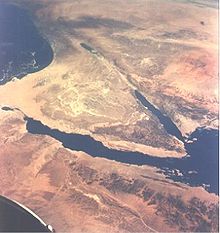

It lies between the Mediterranean Sea to the north, and the Red Sea to the south, and is the only part of Egyptian territory located in Asia as opposed to Africa, effectively serving as a land bridge between the two continents. In addition to its formal name, Egyptians also refer to it affectionately as the "Land of Fayrouz", based on the Ancient Egyptian "Dumafkat", which has the same meaning. The peninsula is currently controlled by Egypt, which has divided the region into two Egyptian governorates, and contains a population of approximately 1.3 million people.
The region has historically been the center of conflict between various political factions, based largely on its strategic geopolitical location. In addition to periods of direct rule by Egyptian governments (including the Ayyubids, the Mamluks, the Muhammad Ali Dynasty, and the modern Egyptian republic), like the rest of Egypt, it was also occupied and controlled by the Ottoman, and British empires. Israel invaded and occupied Sinai twice during the 20th Century, first during the Suez War of 1956, and secondly during and after the Six Day War of 1967. In the October War of 1973, it was the location of fierce fighting between Egyptian, and occupying Israeli forces.
History
Sinai was inhabited by the Monitu and was called Mafkat or Country of Turquoise. From the time of the First dynasty or before, the Egyptians mined turquoise in Sinai at two locations, now called by their Arabic names Wadi Maghareh and Serabit el-Khadim. The mines were worked intermittently and on a seasonal basis for thousands of years. Modern attempts to exploit the deposits have been unprofitable.These may be the first known mines.
The peninsula was governed as part of Egypt under the Mamluk Sultanate from 1260 until 1517, when the Ottoman Sultan, Selim the Grim, destroyed the Mamluks at the Battles of Marj Dabiq and al-Raydaniyya. From then until 1906, Sinai was administered by Ottoman provincial government of the Pashalik of Egypt, even following the establishment of the Muhammad Ali Dynasty's rule over the rest of Egypt in 1805. In 1906, the Ottoman Porte formally transferred administration of Sinai to the Egyptian Government, which essentially meant that it fell under the control of the United Kingdom, who had occupied and largely controlled Egypt since 1882.
The border imposed by the British runs in an almost straight line from Rafah on the Mediterranean shore to Taba on the Gulf of Aqaba. This line has served as the eastern border of Egypt ever since.
At the beginning of the 1948 Arab-Israeli War, Egyptian forces entered the former British Mandate of Palestine from Sinai to support Palestinian and other Arab forces against the newly declared State of Israel. For a period during the war, Israeli forces entered the north-eastern corner of Sinai. With the exception of the Palestinian Gaza Strip, which came under the administration of the All-Palestine Government, the western frontier of the former Mandate of Palestine became the Egyptian-Israeli frontier under the 1949 Armistice Agreement.
In 1956, Egypt nationalized the Suez Canal on the western side of the Sinai Peninsula and also used its control of the eastern side to impose a blockade on the Israeli port of Eilat. Following this, Israeli forces, aided by Britain, and France (which sought to reverse the nationalization and regain control over the Suez Canal), invaded Sinai and took control of much of the peninsula within a few days (see Suez Crisis). Several months later Israel withdrew its forces from Sinai, following strong pressure from the United States, and the Soviet Union. Following this the United Nations Emergency Force (UNEF) was stationed in Sinai to prevent any military occupation of the Sinai.
In 1967, Egypt reinforced its military presence in Sinai, renewed the blockade on Eilat, and on May 16 ordered the UNEF out of Sinai with immediate effect. Secretary-General U Thant eventually complied and ordered the withdrawal without Security Council authorization. Subsequent to Egyptian actions, Israel invaded Sinai, commencing the Six-Day War in which the Egyptian army was defeated, and Israel captured and occupied the entire peninsula. The Suez Canal, the east bank of which was now controlled by Israel, was closed.
In the October War of 1973, Egyptian engineering forces built pontoon bridges to cross the Suez Canal, and stormed the supposedly impregnable Bar-Lev Line while many Israeli soldiers were observing the holiday Yom Kippur. Though the Egyptians maintained control of most of the east bank of the Canal, in the later stages of the war, the Israeli military crossed the southern section of Canal, cutting off the Egyptian 3rd Army, and occupied a section of the west bank. After the war, as part of the subsequent Sinai Disengagement Agreements, Israel withdrew from the Canal, with Egypt's agreeing to permit passage of Israeli ships.
In 1979, Israel and Egypt signed a peace treaty in which Israel agreed to withdraw from the entirety of Sinai. Israel subsequently withdrew in several stages, ending in 1982. The Israeli pull-out involved dismantling almost all Israeli settlements, including the town of Yamit in north-eastern Sinai. The exception was Ofira, which became the resort town of Sharm el-Sheikh. The Treaty allows monitoring of the Sinai by the Multinational Force and Observers and limits the number of Egyptian military forces in the Peninsula.
Present
The Sinai Peninsula is currently divided among two Egyptian governorates, or provinces. The southern portion of the Sinai is called Ganub Sina in Arabic, literally "South of Sinai"; the northern portion is named Shamal Sina', or "North of Sinai". The other three governates converge on the Suez Canal, including el-Sewais, literally "the Suez"; on its southern end and crosses into African Egypt. In the center is el-Isma'ileyyah, and Port Said lies in the north with its capital at Port Said.
Approximately 66,500 people live in Ganub Sina and 314,000 live in Shamal Sina'. Port Said itself has a population of roughly 500,000 people. Portions of the populations of el-Isma'ileyyah and el-Suweis live in Sinai, while the rest live on the western side of the Suez Canal in Egypt-proper. The combined population of these two governorates is roughly 1.3 million (only a part of that population live in the Sinai, while the rest live on the western side of the Suez Canal). Sinai is one of the coldest provinces in Egypt because of its high altitudes and mountainous topographies. Winter temperatures in some of Sinai's cities and towns reach −16°C.
Over the past 30 years the Sinai has become a tourist destination due to its natural setting, rich coral reefs, and biblical history. Large numbers of Egyptians from the Nile Valley and Delta have moved to the area to work in tourism, while at the same time development has robbed native Bedouin of their grazing land and fishing grounds. This clash of cultures has resulted in the Sinai becoming the site of several terrorist attacks targeting not only Westerners, and Israelis, but also Egyptians on holiday and working in tourism.
In order to help alleviate the problems faced by the Sinai Bedouin due to mass tourism, various NGOs have begun to operate in the region including the Makhad Trust, a UK charity who assist the Bedouin in developing a sustainable income whilst protecting Sinai's natural environment, heritage and culture.
http://en.wikipedia.org/wiki/Sinai
Friday, April 24, 2009
Oyun Musa Fortified Firing Position Sinai


For anyone wondering what lies up on that hill, and what is beyond the huge camouflaged helmet on your right as you drive South towards Ras Sidr, it is well worth a visit.


On 5th -10th June 1967 when the Israeli Army invaded yet another one of it's many neighbours namely Egypt and occupying the Sinai, few people would have guessed that the constant aggression shown by the Israeli's to it's middle eastern neighbours, and in particular the cruel and inhumane treatment shown to the original owners of occupied Palestine, the Palestinian refugees would today have escalated into International terrorism on such an unimaginable scale, with suicide bombing now rife in the region and beyond.

Zionist aggression with the help the of the US military war machine, completely destroyed in a surprise attack on the undefended Egyptian people, the Egyptian Air Force in a raid that led to the invasion of Sinai and it's occupation for 6 years by the Israeli Army.
Oyun Musa Fortified Firing Position was a military stronghold used by the invading Israeli's to launch attacks on the civilian population of Suez, it's oil wells and the Sinai infrastructure. The railroad in Sinai was destroyed by being lifted and used to reinforce the Israeli bunkers of which you can see in some of the photographs leaving Sinai with no railway lines.

The bunkers were heavily fortified and have sliding metal doors which were swung closed after every rocket launch to avoid detection by the Egyptian army at Suez ( also seen in the photographs ).

1973 saw the retaking of the Egyptian land again from the aggressors and Egypt's Sinai was once again returned to it's rightful owners.
The Oyun Musa Fortified Firing Position remains as a reminder of the Egyptian victory against the invader, and today Egyptian soldiers act as guides, showing visitors around the site for a very small entrance fee.

.
There is a visitor centre with Israeli soldier artifacts, an observation deck with high powered binoculars which reach to Suez, bunkers and military hardware on show.


Subscribe to:
Posts (Atom)