We know a great deal about the ancient Egyptians thanks to the documentary detail in the thousands of miles of wall paintings and stone engravings with which they decorated their temples and tombs. We even know what they ate, how they grew, gathered and prepared their food, even what they flavored it with. And because of the basic conservatism of the Egyptian people, it is possible today to breakfast or dine off the same dishes that the pharaohs and scribes and pyramid-builders ate thousands of years ago.
Of course, since then, new fruits, grains and vegetables have been brought in and domesticated. In recent centuries, the Turks have imparted unmistakable flavors and textures to many dishes.
Before that Arabs, Romans, Greeks and Persians made their contributions. But the basic elements of Egyptian cooking—the beans and onions, cereals and bread, the fish from the Nile and the ducks from Fayyoum, the melons and pomegranates and dates, the coriander, cumin, rosemary and sage—remain as they were at the time of Ramses the Great and Akhnatoun.
The tombs abound with pictures showing the making of bread and beer—two jobs conveniently combined by the bakers because of their control of the supplies of yeast.
The ancient Egyptians are believed to have been the first people to make leavened bread.
Actual examples of bread made 4,000 years ago have been found in sealed tombs that were recently opened. Egypt was one of the main suppliers of wheat and barley to Rome, and wild barley is still found on the shores of the Red Sea, where it was originally discovered by the goddess Isis.
Some ancient Egyptian foods, however, are no longer eaten, at least not in quantity.
The lotus and the payrus, the two main flower emblems of old Egypt, are not usually thought of as edible.
The green stem of the papyrus, though a little tough, is sweet to chew, while the flowers of the white or blue lotus make a tasty salad. Today people will tell you that the wild lotus, which once grew prolifically in the swamps and lakes of the Nile, has vanished.
But recently, one evening at dusk, we were driving along a dusty road beside a small canal somewhere in the northern Delta, when a young boy emerged from the bushes bearing in his arms an immense pile of wild lotus flowers, drooping and top-heavy on their long stems, just as they appear on the walls of the tombs. To see this boy appear, his arms full of lotus, was as if countless centuries had melted and we ourselves were alive and breathing in the distant past.
An easier way to get a taste of the past is to eat the onions and beans of Egypt.
They are consumed in vast quantities by the modern Egyptians and, according to the pharaonic texts and wall paintings, they were just as popular in ancient times.
The onion, and the closely related garlic and leek families, had an almost religious, or at least medicinal, significance in ancient Egypt.
Wall paintings show priests holding up bunches of onions; papyrus texts tell of special days for chewing onions, days for tying onions around the throat or stomach, and a day for walking with onions in procession. On the arrival of a new season's crop, onion and garlic festivals were held. To this day, on the eve of Sham an-Nassim, Egyptians put a piece of green onion or garlic under their pillows and on waking the next morning crush the piece and smell it before going out to "sniff the breezes" on the first day of spring.
Most Egyptians begin their day, every day, with beans—foul madamis, if not the national dish, is at least the national breakfast.
Dried broad beans are boiled all night in large, cylindrical copper pots, tightly closed, over an extremely low fire. By dawn these pots have been delivered to every kiosk and restaurant in town, including luxury hotels like the Sheraton and Hilton.
The foul madamis is ladled out into thousands of small pots and plates and simply dressed with olive oil and lemon.
Ta'miyah, another popular bean dish, is made of peeled broad beans pounded to a paste with the leaves of leeks, parsley, coriander, plus coriander seeds, red pepper and much garlic, then dropped by spoonfuls into boiling oil for a few seconds and eaten hot. Biting into the crisp brown crust of ta'miyah—called falafil in the rest of the Arab world—reveals a heart that is bright green from all those leaves. A duller, pea-green is bisara, a kind of porridge made of dried green beans, boiled with onions, garlic, oil and butter and flavored with leek, mint, dill, coriander and parsley.
Egyptians like their food spicy, and the pharaonic tombs reveal that this is a very old tradition. The tombs contain actual samples of sage, rosemary, anise, fennel, cumin and coriander preserved for use in the afterlife. Coriander was a particular favorite; it was not only a flavoring but considered to have medicinal properties; even today many Egyptians take coriander seeds for heart and liver troubles.
Coriander is also an essential ingredient in what is Egypt's true national dish—and eaten and known as Egyptian throughout the Middle East—mulukhiyah. This is made from a spinach-like pot-herb, Corchorus olitorius ("Jew's mallow," according to Webster's). The leaves are cut and recut until they become almost a green paste. Chicken or rabbit broth is then poured over the chopped leaves, along with butter, garlic and green coriander. A few minutes of boiling turns the dish a blackish green, ready to be ladled over plates of rice, pieces of dried bread and chicken, lamb or young rabbit. Vinegar is sometimes added. Either you like it or not: it is somewhat slimy and stringy in consistency, but most Arabs find the very name mulukhiyah mouth-watering.
A vegetable of similar mucilaginous consistency popular in Egypt is bamyah—none other than our old friend from the Deep South, okra, a member of the hibiscus family. In Egypt the dark green pods, containing masses of fine white seeds, are carefully arranged in layers of radial circles, like the spokes of wheel. A little minced meat and garlic is added and the dish given extremely slow cooking for many hours. Just before serving, a few drops of fresh lime juice are added.
Stuffed leaves and vegetables are eaten throughout the Middle East, sometimes with a flavoring of meat, sometimes cooked in oil. In Egypt, grape leaves are picked in March and April, when the vines send forth tender new leaves, and stuffed with a bit of rice and flavoring. Other leaves—lettuce, cabbage, anything as long as it's not poisonous—are also stuffed. Since pharaonic times the humble cabbage has been a favorite. The leaf is first dipped in boiling water to make it pliable, then wrapped round a mixture of rice, minced mutton, a few grains of mastic, and chopped coriander, then arranged in rows in a pot and slowly simmered in broth.
Egypt is blessed with an abundance of fish, fresh-water from the Nile and salt-water from both the Mediterranean and the Red Sea. The giant Nile perch is said by some to be getting bigger and better on the rich food supplies banking up behind the High Dam at Aswan.
"Aboukir" shrimp come from the bay where Nelson destroyed Napoleon's fleet in the Battle of the Nile. The Red Sea produces prawns and other Crustacea. But, above them all, is the buri—a grey mullet from the sea—which is served both fresh and salted and also provides that connoisseur's delight, batrakh, or pressed Egyptian "caviar."
"The Shining Virtues of the Good Things of Egypt and Cairo"—written in 1483 by Ibn Zuhayra and mainly quoting an earlier Egyptian writer of about A.D. 900—speaks of the best salted fish as coming from the northern Delta, where it was the special food of weavers and dyers working in the cloth factories of the area.
The fish was "sent salted to the horizons," Ibn Zuhayra says. It may well have been the buri, which comes from the northern Delta and is sent everywhere.
The buri is considered to be at its best in the early spring when it stops eating and becomes known as buri sayim, "fasting mullet." At this time of the year, the fish begin to pass in great numbers from the salt marshes of the Delta into the open sea. It so happens that, at about the same time, the Copts of Egypt are beginning their own lenten fasts and are in need of large quantities of fish.
The fasting mullet has two advantages: it can be cooked and eaten without cleaning, and—as it is also the breeding season—the female buri is filled with eggs. The ovaries are dried in the sun in much the same wav as shown on the walls of the Old Kingdom tombs at Saqqara.
Dried and pressed, the eggs appear as long amber bars about three inches long, best eaten very thinly sliced on slivers of dry toast accompanied by equally thin slivers of lemon. Unfortunately, unlike most other Egyptian delicacies, but like all caviar, batrakh is very expensive.
Wild ducks flap their wings or hang in the hands of servitors in many of the tomb paintings. Today the hunting of wild ducks is confined to a few migratory birds alighting in season in the salt marshes of the Delta. But the oasis of Fayyoum, west of the Nile, specializes in raising ducks for the table. Roast Fayyoum duck, stuffed with, fireek (cracked wheat gathered green and dried), onion, the small, wiry variety of Egyptian celery, and then liberally basted with orange juice, is an Egyptian dish for special occasions.
If wild ducks are rare, almost every farmhouse has its pigeon tower made of Nile mud. The mud is important, for the pigeons have an intense dislike for modern concrete towers and more than one Delta farmer has found his newly built tower quickly abandoned in preference for the old mud one. In some parts of the Delta there are veritable pigeon cities—lofty skyscraper complexes housing tens of thousands of pigeons—for pigeons are also raised commercially and served in the most sophisticated restaurants as well as the most humble homes.
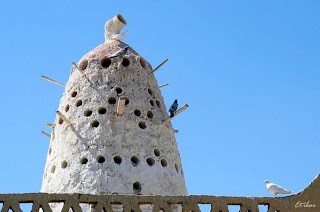
Few dishes are more Egyptian than pigeon cooked with fireek. Pigeon stuffed with fireek and basted with liquid swells as the grain inside expands till it has a full, rounded, almost sexy appearance. Alternatively the pigeon can be completely covered and cooked inside a mound of fireek, to which is added fresh cream, a little garlic and butter, and onions. The dish emerges as a brown crusty mound, with the pigeons moist and succulent inside the steaming fireek.
A word about meat in Egypt. The meat most often served in Middle Eastern countries is lamb or mutton, and Egypt produces its full share of sheep, whose meat can be very succulent. However, Egyptian cooking also features a kind of beef—known on the hoof as gamous, or water buffalo. Egyptians usually eat it in made-up dishes, but it can be cooked as steaks or kebabs, and many a Westerner has eaten it under the impression that he is eating beef.
All these dishes—with the exception of the "caviar"—are common, everyday events in many Egyptian households. But as in many lands, it is not always easy to find everyday, local foods in the big international hotels and restaurants.
Egyptian fish and shrimp are easily found in most good restaurants. The delightful bean dishes—ful madamis, ta'miyah, bisara—have been admitted to the menus of some leading hotels, or can usually be produced by special arrangement.
In Cairo 'Le Meridiene Hotel' serves many local dishes at its Saturday night oriental buffet, and the Hilton and Sheraton bring forth a few Egyptian specialties for the adventurous traveler. And nearly all the simple local dishes are to be found at the charming Fil Filla restaurant, to be savored in the courtyard under the dappled sunlight of living vines.
The Egyptians usually end a meal with fruit, and the walls of the tombs give evidence that their ancestors also enjoyed the fruits of Egypt—grapes, guavas, melons and pomegranates in particular. Other fruits, arriving centuries later, have since become Egyptian in every sense—mangoes, oranges, limes, apricots, mandarines.
One of the joys of an Egyptian summer is to see these fruits from different parts of the country borne proudly into the city in small woven baskets on the heads of street vendors. In season come grapes from Fayyoum, very sweet dates from the distant oasis of Siwa, green and purple figs from Alexandria and Mersah Matruh, and summer melons from Ismailia and the banks of the Nile. The street vendors chant the virtues of their wares: "Buy my pomegranates . . . like maidens' cheeks.
" Today the fruit and flowers of the flaming pomegranate are as much sought after for their juice and as decoration as they were when this fruit was celebrated in old Egyptian poetry and used to decorate the tomb of the pharaoh Akhnatoun.
In ancient times, figs were often gathered with the help of monkeys; and in even-temple in the land were giant stone columns representing the trunk of the date palm. The date was one of Egypt's commonest foods, eaten fresh, dried or pressed into cakes.
But above all other fruits, in a desert land, it is the melon—pale green, salmon pink, creamy white, or bright red—that provides the greatest refreshment. Sweet and succulent, scented with musk, dripping with juice, the Egyptian melon can be sheer ecstacy after an outing in the blazing summer sun.
According to tradition, the batikh, or watermelon, should be cut an hour or so beforehand to cool by evaporating in the air.
Another piece of ancient advice still considered to be true is this: "But it is always wise to watch the melon during this time, lest a serpent should come and poison the melon by its breath or bite; for reptiles are said to be extremely fond of melon and smell it at great distances."


